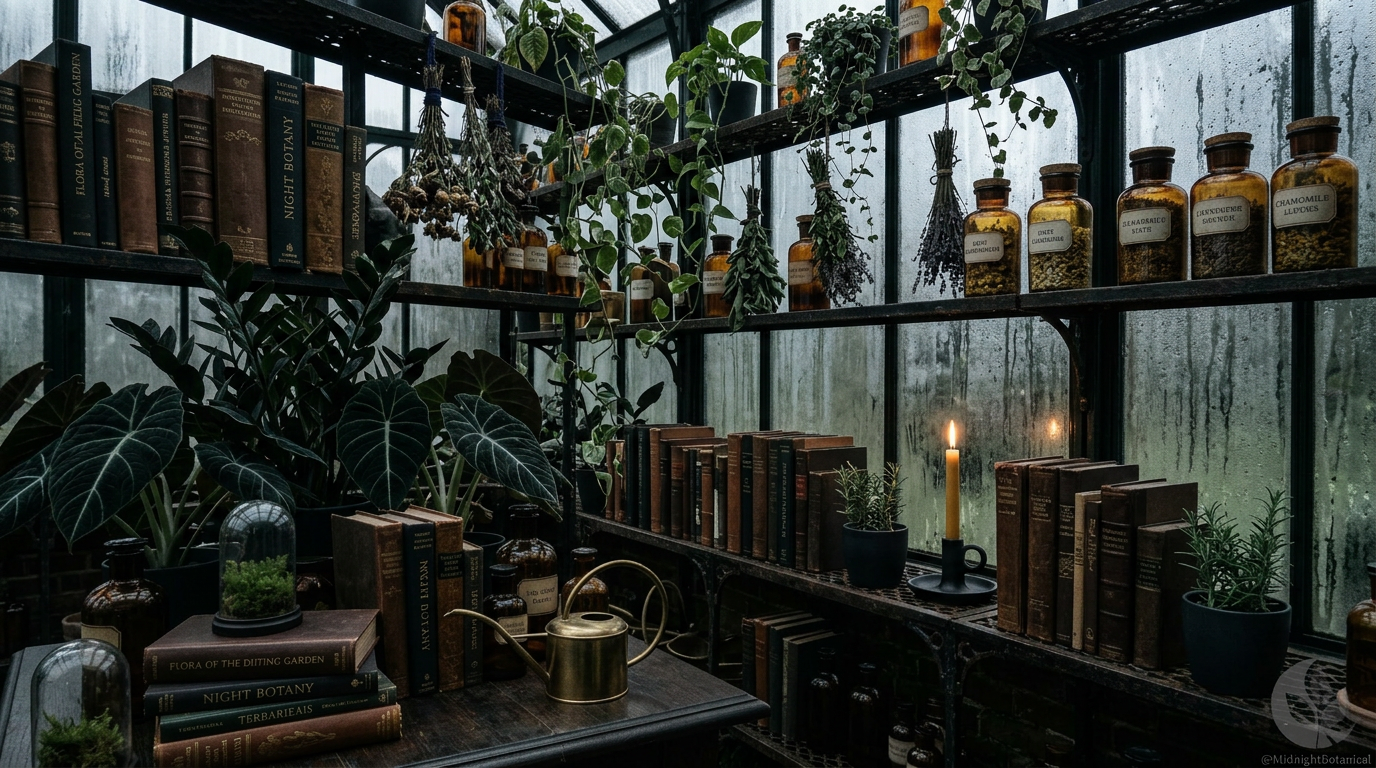
Tag: witch herb garden study

  • The Herbalist’s Study: How to Style an Apothecary Bookshelf with Living and Dried Plants

    The Herbalist’s Study: How to Style an Apothecary Bookshelf with Living and Dried Plants


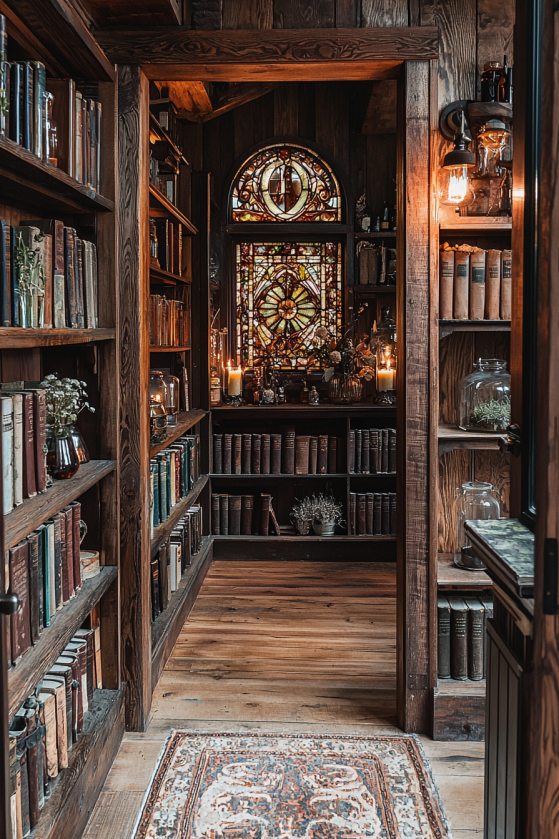
    There is a smell that precedes the study before you enter it. Dried lavender, and clove, and something older — the mineral edge of ink on aged paper, the faint resin of beeswax spent slowly in the dark. You stand at the threshold and know, without needing to see, that someone here understands plants the way scholars understand language: not as ornament, but as specimen. Not as color, but as text.
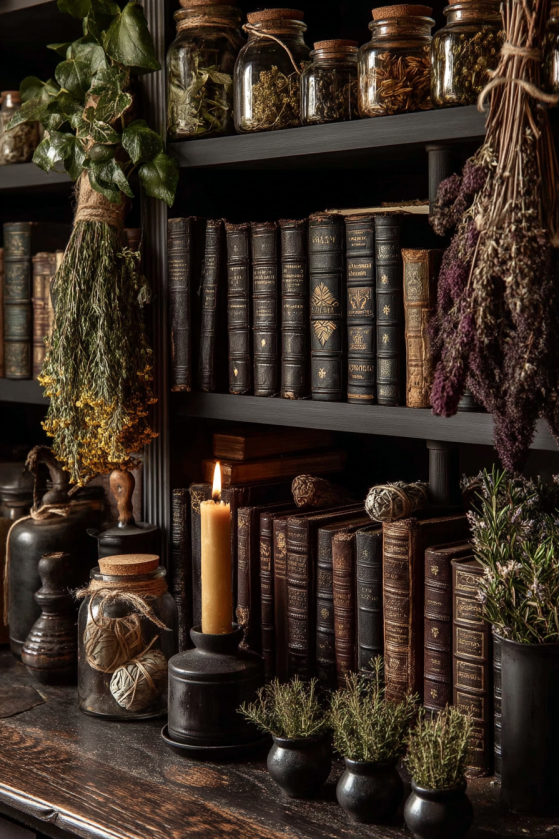
    This is the herbalist’s study — built around apothecary aesthetic plants, dark glass, dried herbs, and the slow accumulation of botanical knowledge. And if you have spent hours pinning the amber glass and the candlelit bookshelves and the trailing pothos and the witchy dried bundles — wondering how to make something that real, that dense, that deliberate — this is your guide.


    What Is an Apothecary Aesthetic Bookshelf?
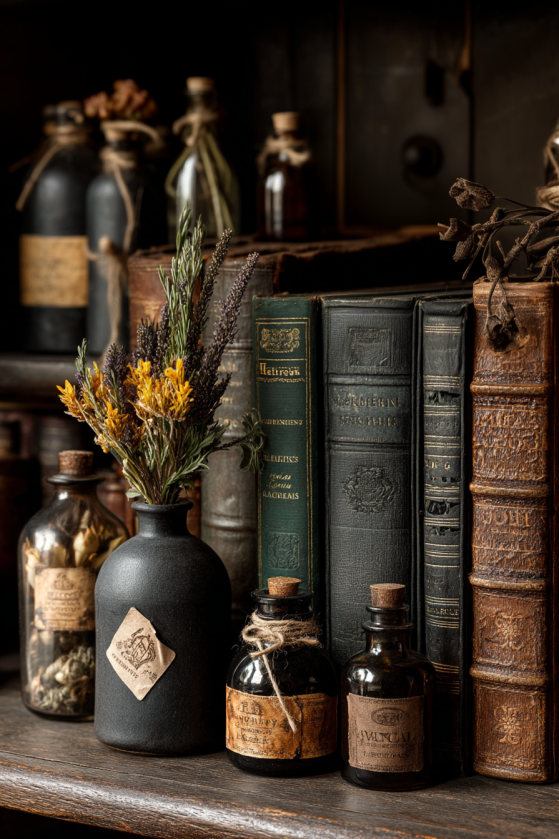
    The apothecary aesthetic is not a trend. It is an orientation — a way of arranging knowledge and nature in the same space, treating both as equally serious, equally alive.

    In the original tradition, the apothecary’s shelves held field guides beside dried root bundles, handwritten remedy cards beside specimen jars of pressed matter. Today, the herbalism aesthetic bookshelf translates that logic into a visual grammar: one part botanical laboratory, one part scholarly archive, one part living ritual practice.

    To style one is to make a quiet argument — that your home is a place of study. That the plants you keep are not merely atmospheric. That the books are not merely decorative. That the amber glass jar on the second shelf contains something worth knowing.
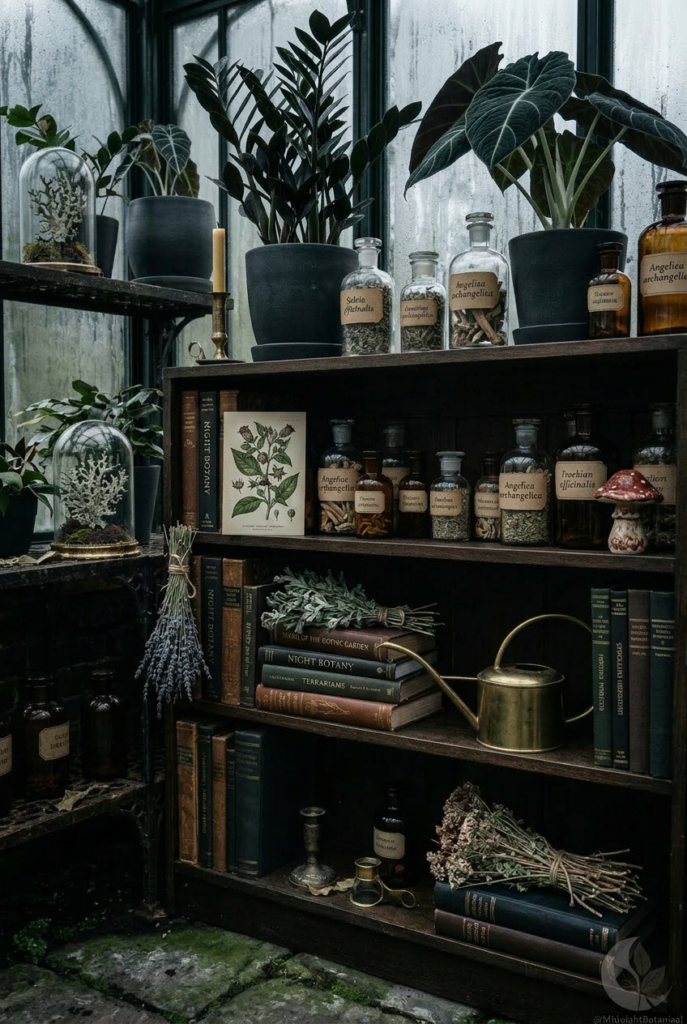
    The key elements of a true apothecary aesthetic bookshelf:

    • Apothecary glass vessels — amber, clear, or dark glass, sealed with corks, filled with dried herbs or seeds or silence
    • Dark-spined books — herbalism field guides, botanical history, folk magic, dark academia — volumes that look as though they have been read
    • Living plants — architectural, low-light varieties that hold their form in dim conditions
    • Dried botanicals — lavender, mugwort, rosemary, bay, pressed ferns, hanging or laid flat between pages
    • Dark ceramic pots — matte black, slate, forest green, dark terracotta
    • Candleholders — beeswax tapers, black pillars, squat lanterns — not scented, or barely
    • Natural specimens — pressed leaves, seed pods, feathers, moth wings, anything found slowly

    Choosing Apothecary Aesthetic Plants for the Dark Herbalist’s Study
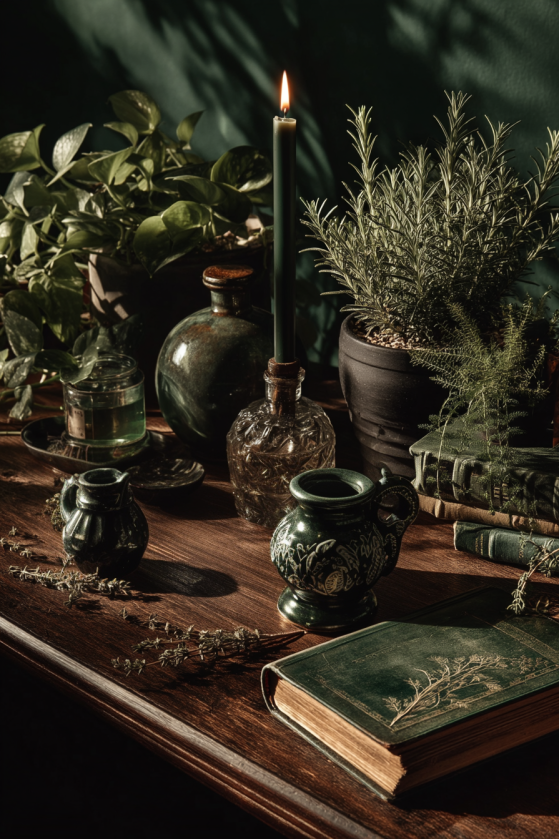
    Not every plant belongs in the herbalist’s study. The space asks for species with a particular character — ancient, or useful, or possessed of a melancholy beauty that photographs well in grey light.

    Living Herbs for the Apothecary Shelf

    The ideal living plants serve double duty: visually dramatic and genuinely useful to the working herbalist.

    • Rosemary — deeply historical, architecturally striking, intensely aromatic. A sprig bruised between the fingers fills a room with something close to memory.
    • Lemon balm — pale, slightly ghostly in low light, said by herbalists to ease the anxious mind. Grows rapidly and generously.
    • Holy basil (tulsi) — peppery, sacred, with dark stems that photograph with unusual intensity.
    • Mugwort — silvery-grey leaves, soft and haunted, the most atmospheric of the witch herb garden classics.
    • Aloe vera — the ancient apothecary plant. Architectural, commanding, quietly useful.
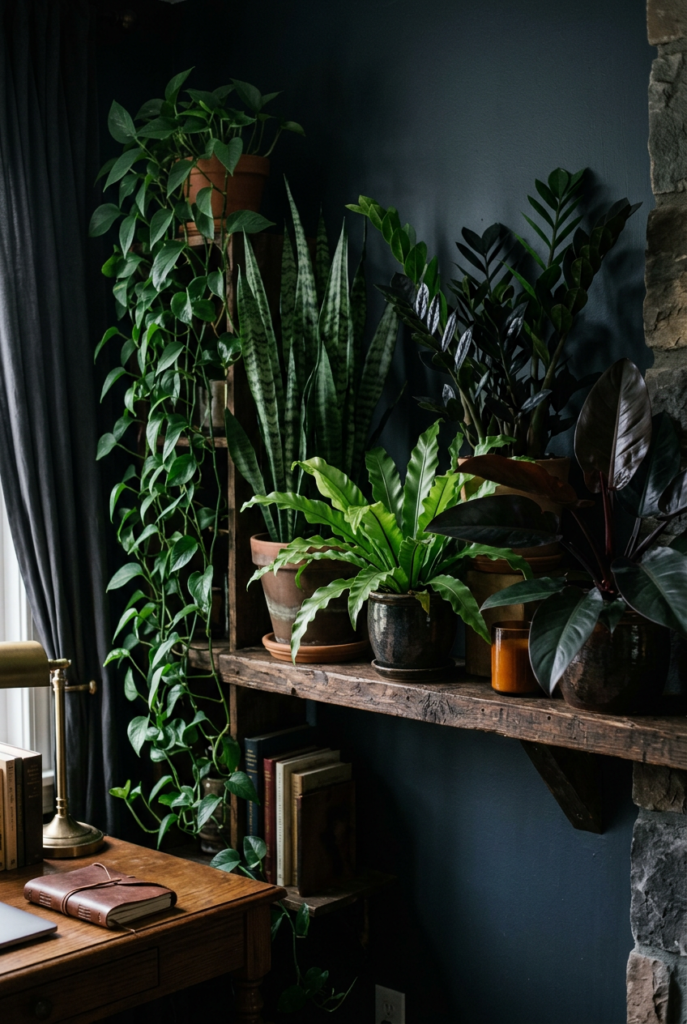
    Low-Light Botanicals for the Dim Sanctum

    For studies without southern exposure — rooms that live in grey light and shadow:

    • Pothos — trails from shelves in long dark-green ropes, one of the few truly reliable performers in near-darkness.
    • Snake plant (Dracaena trifasciata) — vertical, architectural, nearly indestructible.
    • ZZ plant — waxy leaves in some cultivars approaching near-black. A specimen in the truest sense.
    • Bird’s nest fern — Victorian botanist energy, wide dark-veined fronds, grows slowly and deliberately.
    • Philodendron Black Cardinal — deep burgundy-black leaves, impossibly dramatic in amber candlelight.
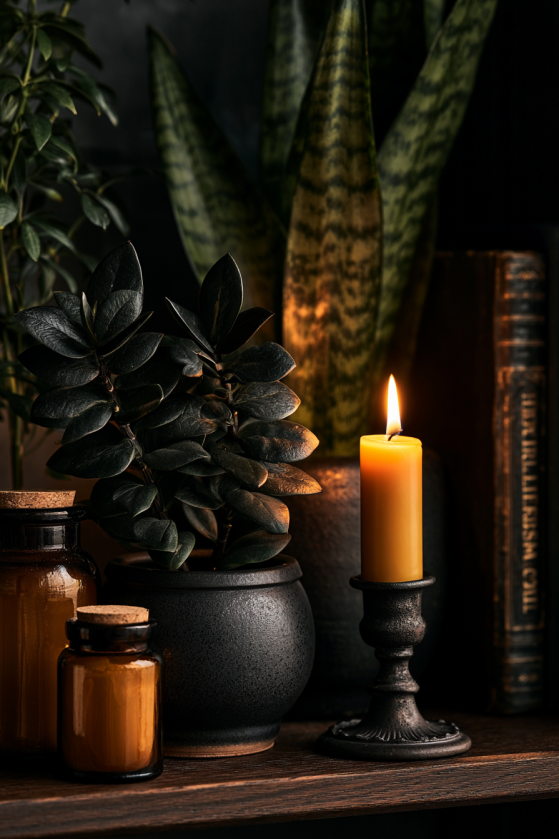
    Layer The Look — Dark Ceramic Pots for the Herbalist’s Shelf

    • Matte Black Ceramic Plant Pot Set, 3–5 inch (Amazon/Etsy affiliate link) — matte black or dark slate-glazed ceramic pots in small sizes, ideal for rosemary, aloe, and fern specimens on the shelf. The pot is the frame — it matters.
    • Matte Black Planters with Drainage Holes, Set of 3 (Etsy affiliate link) — handmade dark ceramic with proper drainage. Sized for the study shelf, not the windowsill.

    Dried Botanicals — The Soul of the Herbalism Aesthetic Bookshelf
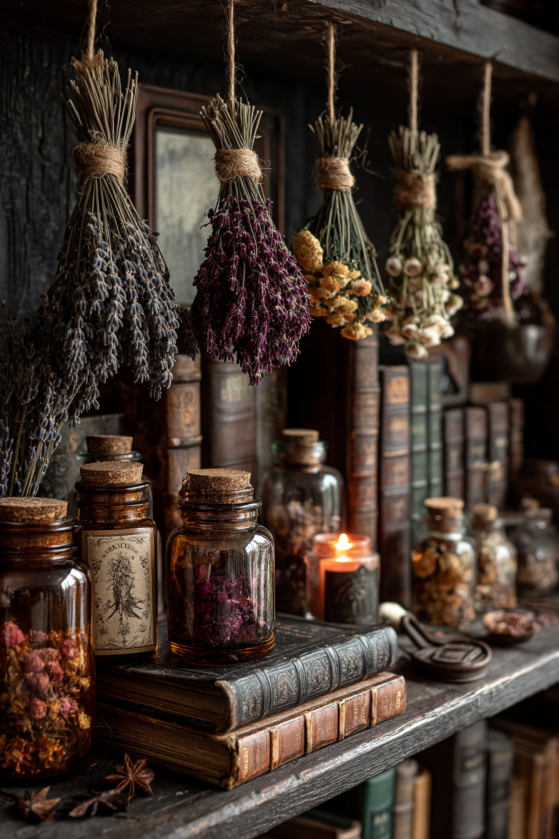
    Where living plants bring motion and breath, dried botanicals bring stillness and depth — the feeling that this study has been accumulating its knowledge for a long time, slowly, like sediment against glass.

    Dried herbs do not merely decorate a shelf. They document it.

    How to use dried botanicals in herbalism aesthetic bookshelf styling:
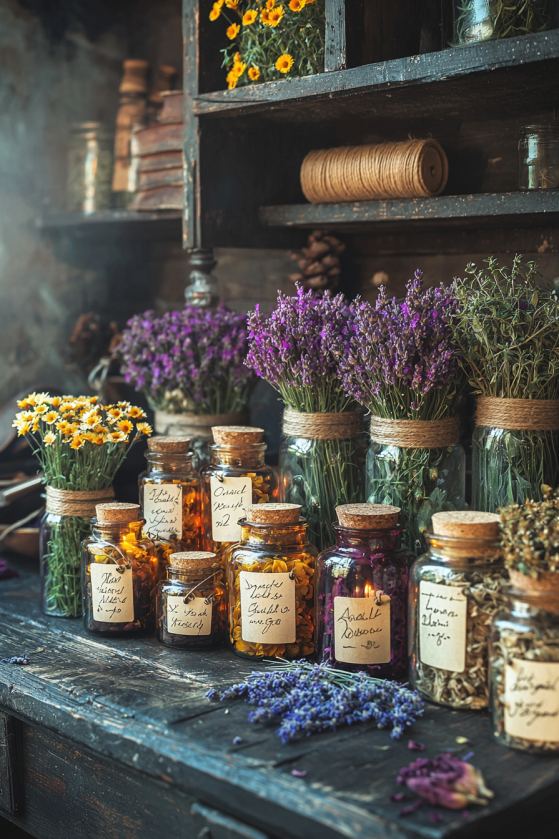
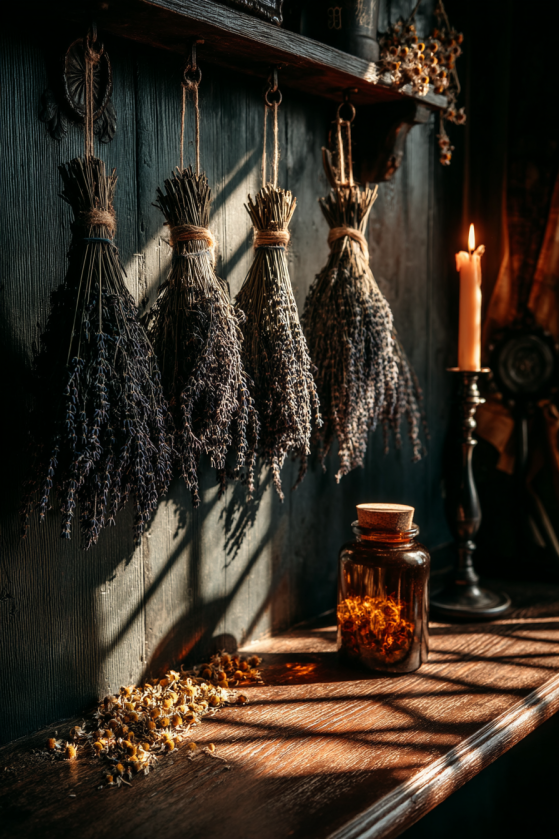
    1. Hanging bundles — bundle lavender, mugwort, or rosemary with dark twine and hang from the shelf edge above. Allow them to dry in place over weeks. The colour change is part of the aesthetic.
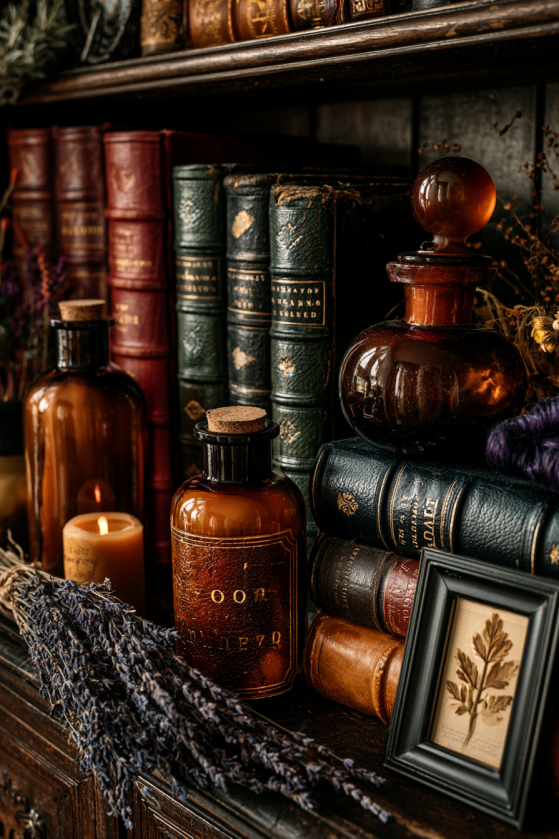
    2. Filled apothecary jars — loose dried chamomile, rose petals, star anise, or whole cloves in amber or dark glass create the classic apothecary shelf. Label in Latin where possible.
    3. Pressed specimens — pressed ferns, seasonal leaves, or botanical matter can be framed and placed within the case like field study specimens, or laid flat between volumes.
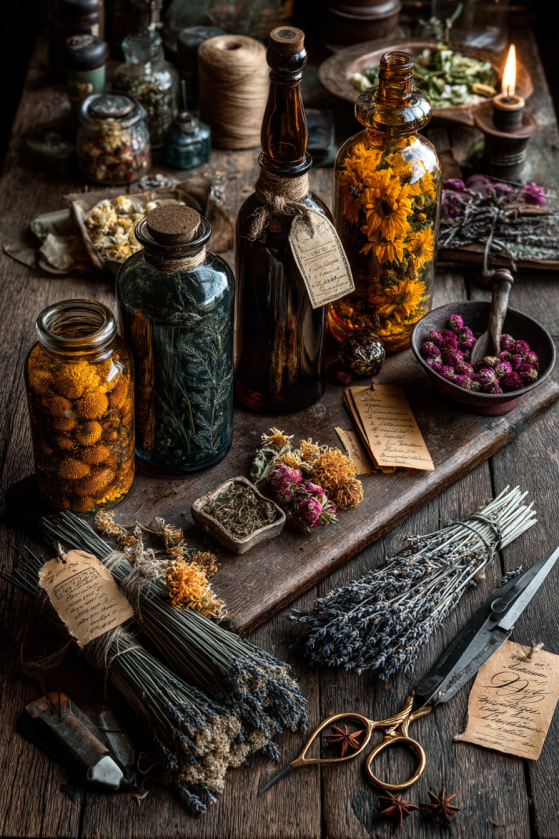
    4. Botanical labels — write or print plant names in Latin on kraft paper tags or aged card labels. This detail transforms a shelf from styled to studied.

    Layer The Look — Dried Apothecary Shelf
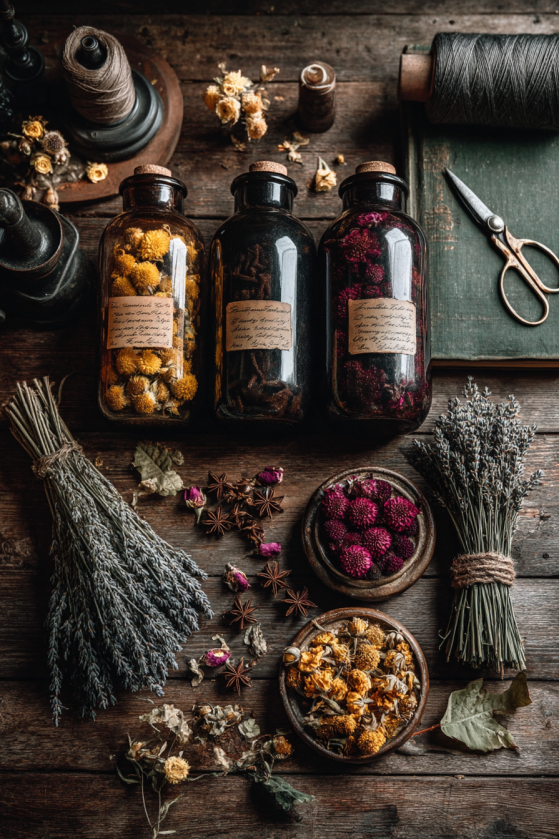
    • Mountain Rose Herbs — Bulk Dried Lavender (affiliate link) — top-quality culinary and decorative lavender for filling jars or bundling. Ships clean, holds colour well.
    • Mountain Rose Herbs — Dried Rose Petals (affiliate link) — deep crimson petals beautiful in amber glass. Hold colour for months on an open shelf.
    • Mountain Rose Herbs — Mugwort Herb, Dried (affiliate link) — silvery, aromatic, the most atmospheric of apothecary herbs. Difficult to source locally; Mountain Rose is the standard.
    • Mountain Rose Herbs — Dried Chamomile Flowers (affiliate link) — pale gold in amber glass. One of the most beautiful jar fills for the apothecary aesthetic.
    • Mountain Rose Herbs — Star Anise, Whole (affiliate link) — architectural, dark, and aromatic. Fills a jar beautifully and doubles as a cooking ingredient.
    • Amber Glass Apothecary Jar Set, 12-piece with Cork Lids (Amazon affiliate link) — properly amber-toned, sized for shelves, with kraft labels included. The foundational vessel set.
    The Book Stack — Dark Academia Titles for the Herbalist’s Study

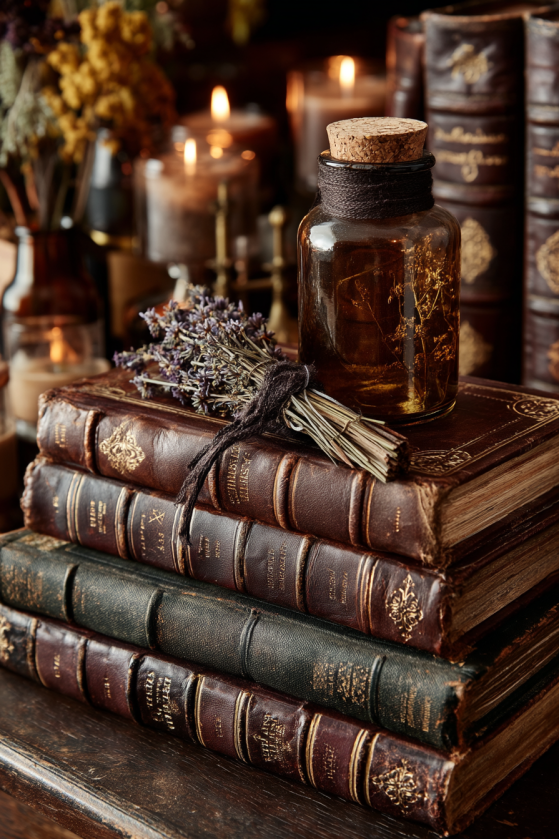
    Every herbalist’s study needs a book stack that means something — not a curated stack, but a working stack. Volumes that have been opened. Volumes with marginal notes and pressed matter between pages.

    The apothecary bookshelf is the intellectual spine of the room. The titles you choose communicate both knowledge and aesthetic at once. Dark spines, matte finishes, aged cloth covers, Latin names on the side.
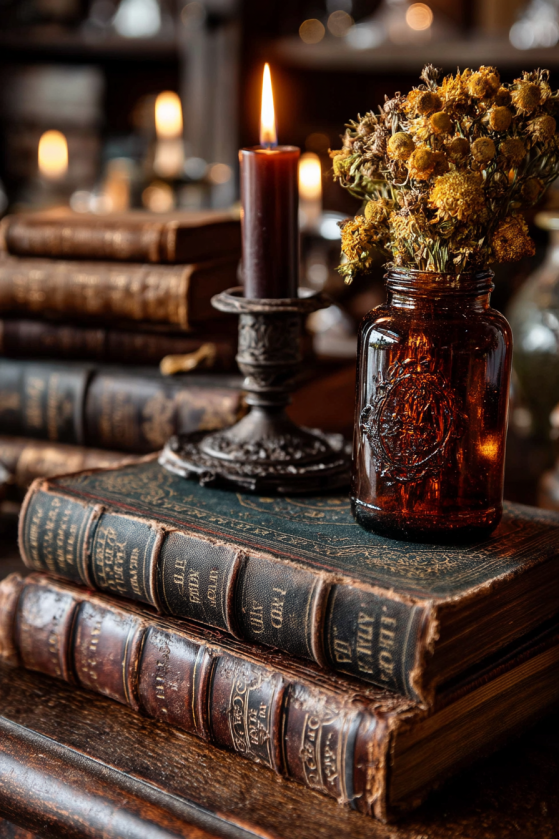
    Curated reading for the dark herbalist:

    • Culpeper’s Complete Herbal — the 17th century apothecary’s bible, available in facsimile editions with period-appropriate covers and Latin botanical names throughout.
    • The Witch’s Herbal Apothecary by Marysia Miernowska — the essential volume on sacred plant work. Photographs are extraordinary.
    • Braiding Sweetgrass by Robin Wall Kimmerer — a quiet meditation on plants and belonging. Scholarly and genuinely moving.
    • The Old Ways by Robert Macfarlane — dark and beautiful explorations of ancient paths and the botanicals that line them.
    • Rosemary Gladstar’s Medicinal Herbs — foundational herbalism text with stunning photography.
    • Regional field guides — any edition with a cloth or aged cover, particularly old pressed-flower guides from charity shops. The patina of use is the point.
    Layer The Look — The Book Stack

    • Culpeper’s Complete Herbal — Facsimile Edition (Amazon affiliate link) — 17th century apothecary reference in vintage facsimile format. The aged cover, the Latin names, the accumulated history of the text itself.
    • The Witch’s Herbal Apothecary by Marysia Miernowska (Amazon affiliate link) — the essential volume for this aesthetic. Stunning cover, sacred plant work, deeply researched.
    • Braiding Sweetgrass by Robin Wall Kimmerer (Amazon affiliate link) — quiet, scholarly, profound. A book that earns its place on any herbalist’s shelf permanently.
    • Rosemary Gladstar’s Medicinal Herbs: A Beginner’s Guide (Amazon affiliate link) — foundational herbalism with stunning photography. One of the most-gifted books in the botanical witch community.
    What’s Selling on Pinterest Right Now

    Trending in the botanical witch aesthetic space — May 2026:

    1. Witchy dark academia with plants — the intersection of scholarly and magical is dominating saves across all dark aesthetic boards
    2. Botanical gothic decor — dark florals, pressed specimens, gothic frames, muted jewel tones
    3. Dark academia bookshelf aesthetic — book stacks with greenery and candles in moody tones
    4. Apothecary home office / moody desk styling — the herbalist’s desk as its own Pinterest genre
    5. Witch greenhouse aesthetic — living botanical rooms, every surface growing something

    Apothecary Home Office Decor — The Herbalist’s Desk
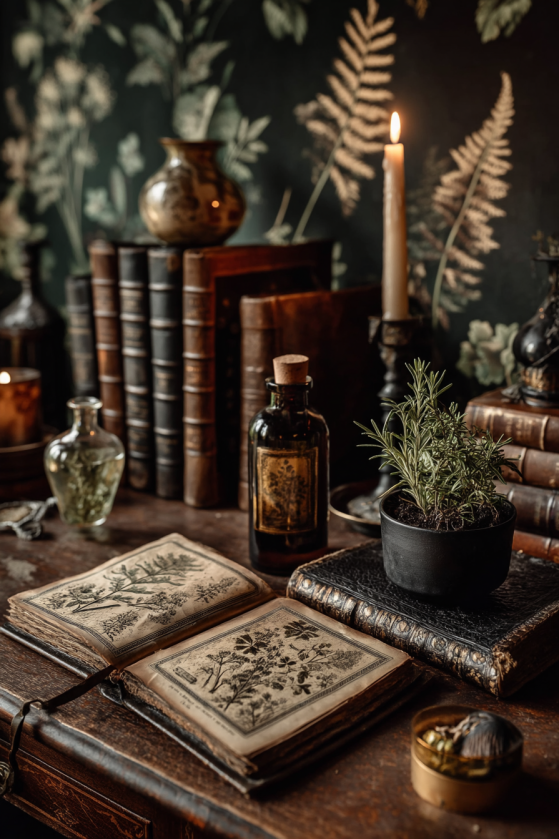
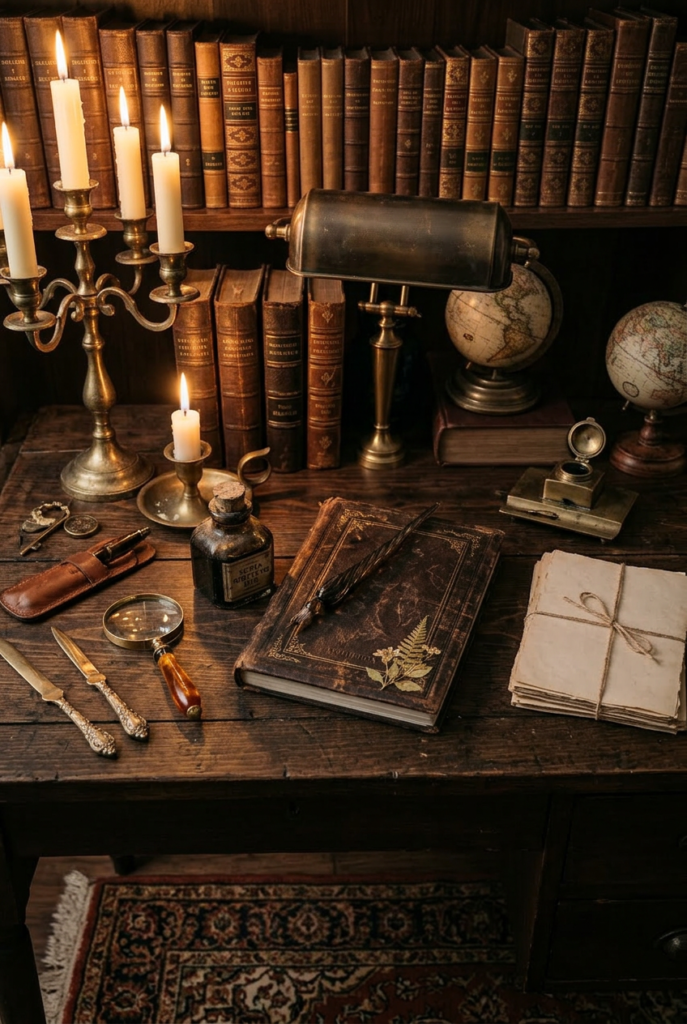
    The desk is the heart of the herbalist’s study. It is where knowledge and practice meet — where you press a sprig between pages, where the candle burns low toward dusk, where the field guide lies open beside something dried and amber-lit. The desk is not styled. The desk is used.

    Desk elements for the apothecary aesthetic:

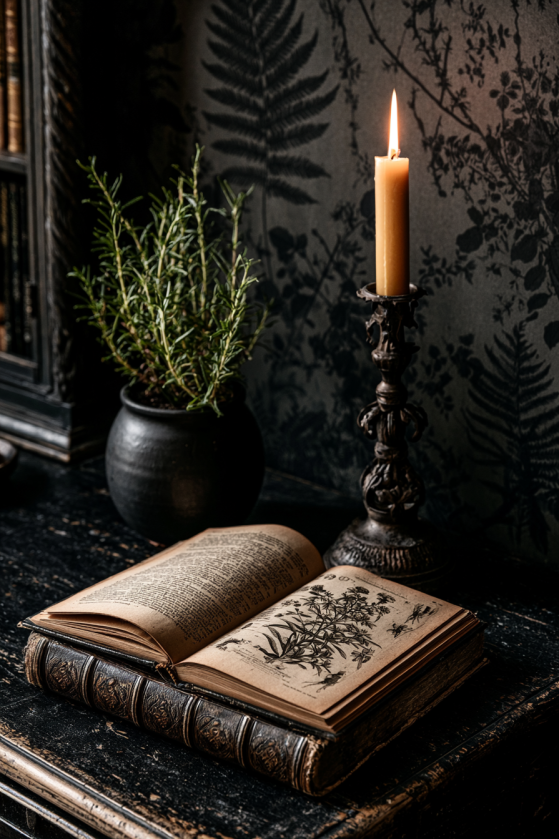
    • One living plant — small and architectural. A sprig of rosemary in a dark ceramic pot. A single aloe. Something that can be brushed past and leave a scent.
    • A working candle — not decorative. Beeswax taper in a dark holder, or a black pillar candle on a slate base. Something that casts actual light.
    • An open book — always, always an open book. The herbalism text you are currently in, or the one you most want to be in.
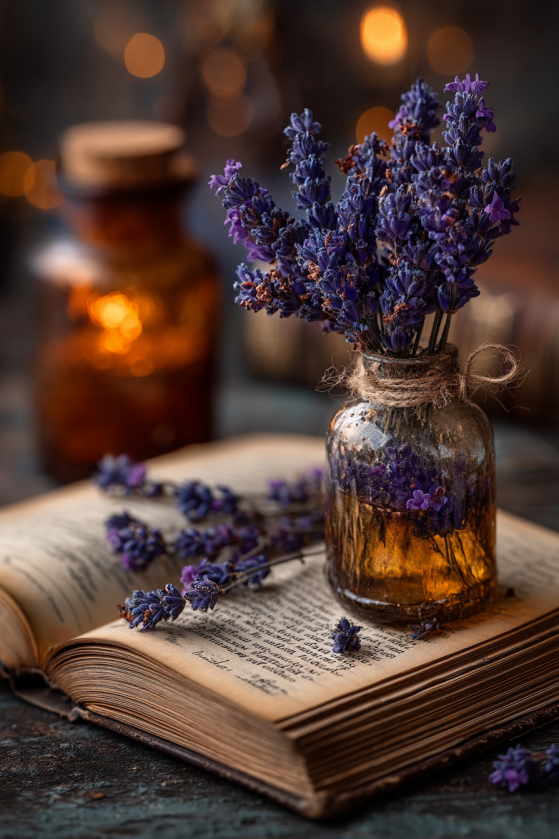
    • One specimen — a single amber jar with something inside. Lavender flowers. A pressed leaf. Something unnamed and interesting.
    • Dark or botanical wallpaper — for those willing to commit: moody black botanical wallpaper behind the desk is the single most dramatic transformation available to this aesthetic.
    Layer The Look — The Herbalist’s Desk

    • Moody Black Botanical Wallpaper, Peel-and-Stick (Etsy affiliate link) — dark forest botanical print in peel-and-stick format. Transformative behind the desk, reversible, rental-safe.
    • Dark Botanical Wall Art Print Set, 4-piece Black Frames (Amazon affiliate link) — pressed botanical specimen prints in black frames. Groups well beside the bookshelf or above the desk.
    • The Witch’s Herbal Apothecary by Marysia Miernowska (Amazon affiliate link) — the desk-worthy volume for this aesthetic. Sacred plant work, stunning visuals, a permanent fixture.
    • Beeswax Taper Candles, Black (Amazon affiliate link) — unscented black beeswax tapers. The right candle is the difference between a styled shelf and an inhabited one.
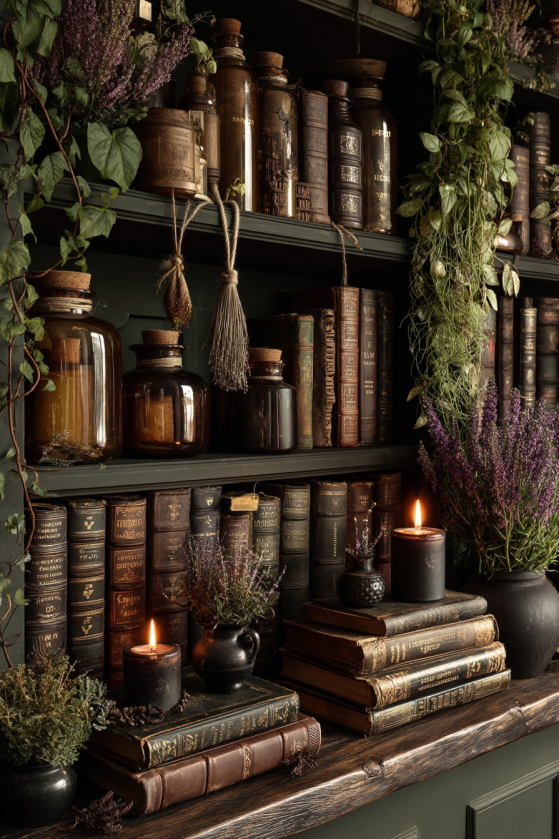
    How to Build a Herbalism Aesthetic Bookshelf — Layer by Layer

    The herbalism aesthetic bookshelf is not assembled. It is built in layers, over time, like sediment. Like knowledge.

    Step 1 — The spine layer.
    Fill the back of each shelf with dark-spined books, field guides, and volumes in muted, aged tones. Let most spines face out. Lay a few volumes flat as risers. The density of books is non-negotiable — this is a scholar’s shelf.

    Step 2 — The vessel layer.
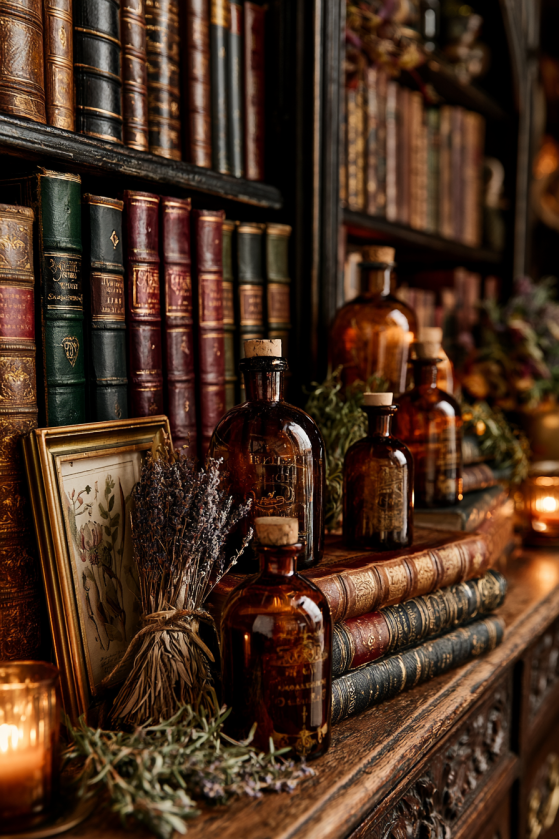
    Introduce apothecary glass — amber, clear, and dark-glazed ceramic. Fill some vessels and leave others empty. Group in odd numbers. Cork-sealed is better than screw-top for this aesthetic.

    Step 3 — The botanical layer.
    Add living plants in matte black or dark-glazed ceramic pots. Trail pothos over the shelf edge. Tuck a small rosemary sprig beside a stack. Let something grow slightly beyond its intended space.

    Step 4 — The dried layer.
    Lay small dried bundles flat beside volumes. Prop a stem of dried lavender in a small vessel. If your shelving allows, hang a bundle from the shelf above. Let things dry in place.

    Step 5 — The light layer.
    Add candles — a squat beeswax pillar, a cluster of tapers in a dark iron holder. Place them where they will catch in the glass and amber. The reflections are the aesthetic.

    Step 6 — The specimen layer.
    A pressed fern in a small dark frame. A moth wing beneath glass. A single specimen in a clear vessel with a label in Latin. Something that says: this is a study, not a showroom.

    [IMAGE 11]

    Layer The Look — Build Your Shelf

    • Amber Glass Apothecary Jar Set, 12-piece with Cork Lids (Amazon affiliate link) — the foundational vessel layer. Properly amber-toned, cork-sealed, label-ready.
    • Matte Black Ceramic Plant Pot Set, 3–5 inch (Amazon/Etsy affiliate link) — for the botanical layer. Dark-glazed and shelf-sized.
    • Dark Iron Candle Holder Set (Amazon affiliate link) — for the light layer. A cluster of tapers in a dark iron holder is the centrepiece of the apothecary light aesthetic. Converts the shelf from beautiful to inhabited.
    • Mountain Rose Herbs — Bulk Dried Lavender (affiliate link) — for the dried layer. Bundle and hang, or fill a jar. Either way, it belongs here.

    Affiliate Picks — The Herbalist’s Study Starter Collection

    [IMAGE 12]

    This post contains affiliate links. If you purchase through our links, we may earn a small commission at no extra cost to you — thank you for supporting MidnightBotanical.

    1. Mountain Rose Herbs — Dried Botanicals Bundle (affiliate link) — culinary and apothecary quality dried herbs for shelf styling and genuine use. Lavender, rose, chamomile, mugwort, star anise. 10% commission.
    2. The Witch’s Herbal Apothecary — Marysia Miernowska (Amazon affiliate link) — the essential book for this aesthetic. Stunning cover, sacred plant focus, deeply researched. Goes beside the jar collection and does not leave.
    3. Amber Glass Apothecary Jar Set, 12-piece with Cork Lids (Amazon affiliate link) — properly amber-toned, shelf-sized, with kraft labels included. The foundational vessel set for this aesthetic.
    4. Matte Black Ceramic Plant Pot Set, 3–5 inch (Amazon/Etsy affiliate link) — matte black or dark slate-glazed ceramic pots in small sizes, ideal for rosemary, aloe, and fern specimens on the shelf.
    5. Moody Black Botanical Peel-and-Stick Wallpaper (Etsy affiliate link) — dark forest botanical print in removable format. The single largest transformation available to the herbalist’s study.
    6. Culpeper’s Complete Herbal — Facsimile Edition (Amazon affiliate link) — 17th century apothecary reference in vintage facsimile format. The aged cover, the Latin names, the accumulated history of the text itself.

    Frequently Asked Questions — Apothecary Aesthetic Plants and Bookshelf Styling
    What plants are best for an apothecary aesthetic bookshelf?

    The best apothecary aesthetic plants for a dark herbalist’s bookshelf are those with historical or medicinal significance: rosemary, mugwort, lemon balm, holy basil, and aloe vera for living herbs; and pothos, snake plant, ZZ plant, or Philodendron Black Cardinal for low-light display. Choose architectural forms in matte black or dark ceramic pots.

    How do I style dried herbs on a herbalism aesthetic bookshelf?

    Style dried herbs in three ways: hang bundles of lavender, mugwort, or rosemary from the shelf edge tied with dark twine; fill cork-sealed amber glass apothecary jars with loose chamomile, rose petals, or star anise; and press botanical specimens flat between books or inside small dark frames. Label in Latin for the full scholarly effect.

    What books belong on a dark academia herbalism bookshelf?

    The essential titles for a dark academia herbalism bookshelf include Culpeper’s Complete Herbal (in facsimile edition), The Witch’s Herbal Apothecary by Marysia Miernowska, Braiding Sweetgrass by Robin Wall Kimmerer, and Rosemary Gladstar’s Medicinal Herbs. Supplement with regional botanical field guides — ideally ones with cloth covers, aged pages, and the satisfying weight of something well-used.

    The herbalist’s study does not happen in an afternoon. It accumulates — a jar here, a bundle there, a field guide slid into a gap between volumes that have been waiting for it. This is not a design project with a completion date. It is a practice, conducted slowly, with attention.

    Begin with one specimen. The amber jar. The dried lavender. The book left open at the pressed-herb chapter. Let the shelf grow in the direction it already wants to go.

    If these ideas are finding root — save this post to your darkest botanical Pinterest board, and follow @MidnightBotanical for more from the herbalist’s study.
  • Dark Academia Study Room Aesthetic: How to Style a Witchy Reading Nook

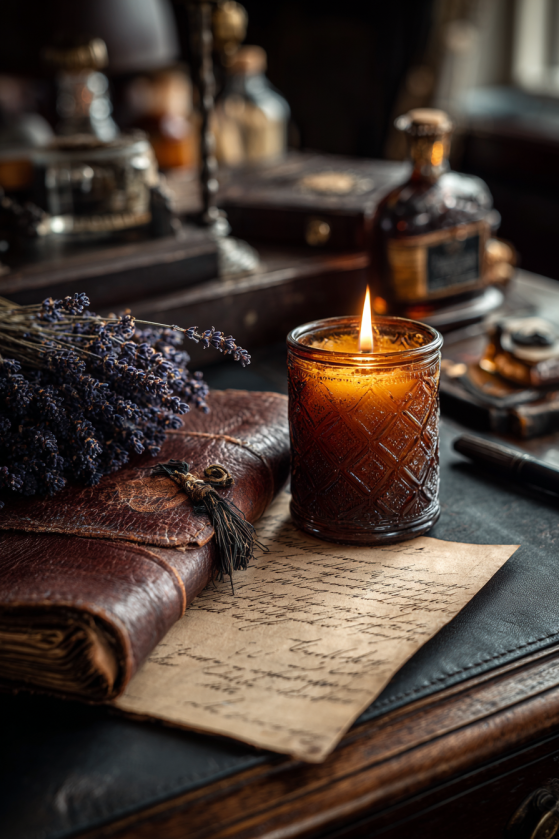
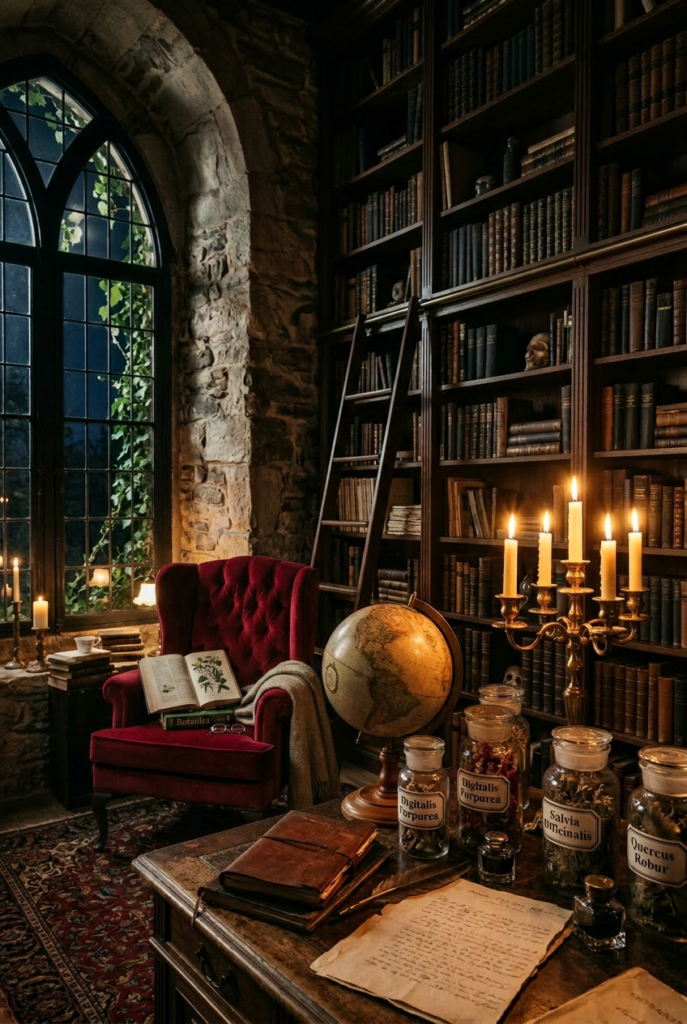
    There is a particular kind of dusk that belongs to the scholar-witch. The sky goes the color of a bruised iris, and somewhere in the house, a candle finds itself lit — not by intention, but by habit. The books arrange themselves into constellations of thought along dark wooden shelves. A spray of dried lavender releases its faint exhale between pages. An apothecary bottle catches the last of the window light and holds it, amber and trembling.

    This is the dark academia reading nook: not designed, exactly, but cultivated — the way one cultivates anything that grows slowly in low light.

    This post is a field guide. A naturalist’s tour through the witchy study corner — its layers, its logic, its objects. By the end, you’ll have everything you need to build one of your own.

    Layer This Look (Starter Pieces to Set the Mood)

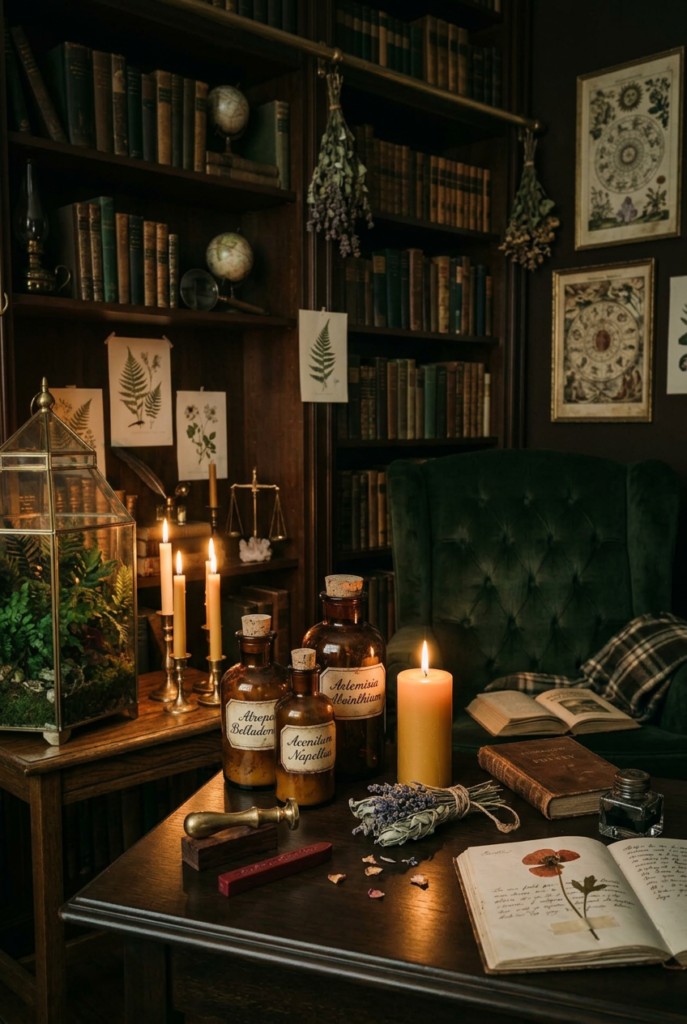
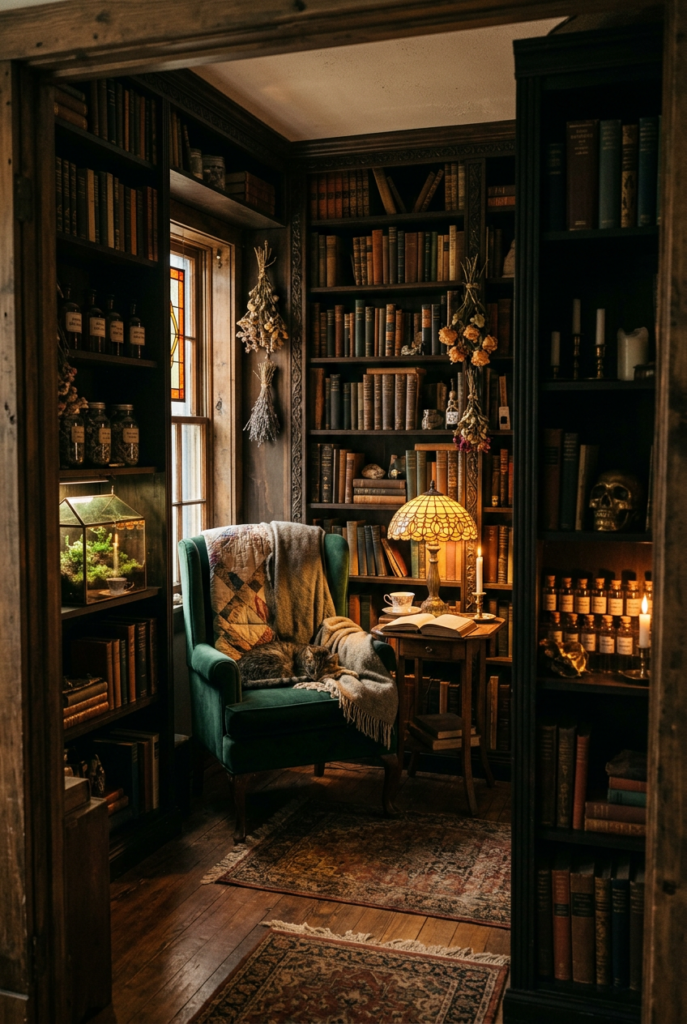
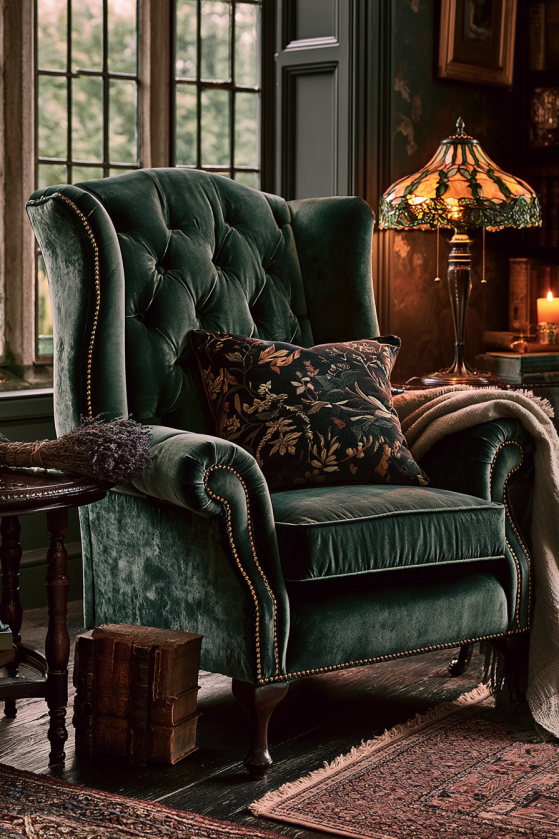
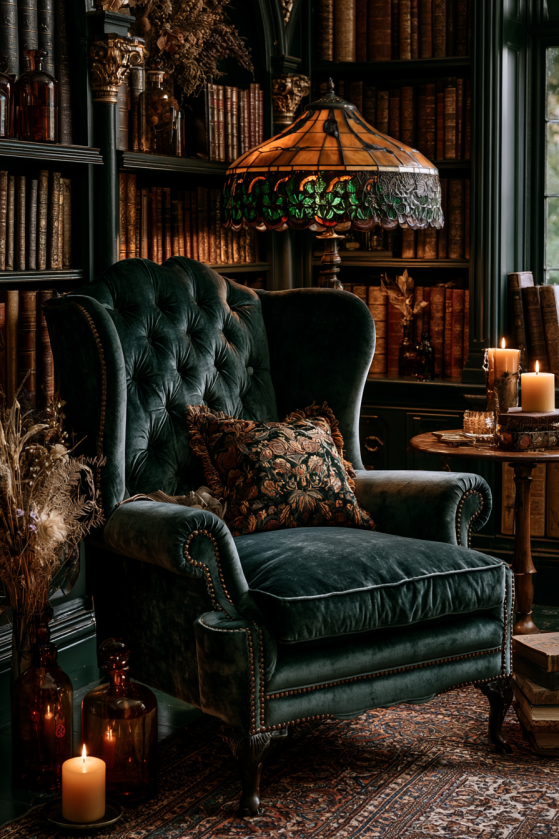
    Build the scholar-witch atmosphere shown in the hero image with a Forest Green Velvet Wingback Armchair as your throne, an Amber & Green Tiffany-Style Reading Lamp for that signature jewelled glow, a set of Amber Glass Apothecary Bottles with Cork Stoppers for herbs and curiosities, Pure Beeswax Pillar Candles for scent and flicker, a Dark Wood Side Table beside the chair, and Dried Lavender Bundles for that faint herbal exhale between pages.

    What Is the Dark Academia Aesthetic?

    Dark academia is the aesthetic language of learning made beautiful. It is candlelight on leather spines, pressed specimens pinned to cork boards, the particular weight of an ink-stained page. It draws from Victorian libraries, Oxford reading rooms, Gothic architecture — anywhere that knowledge and atmosphere exist in the same breath.

    The dark academia study room translates this language into a corner of your home: a chair, a lamp, a shelf, a surface for writing. A place that holds both study and sanctuary.

    The dark academia reading nook is evolving. It’s absorbing the witchy, the botanical, the apothecary — pulling plants, dried herbs, potion jars, and pressed flowers into its vocabulary alongside the books. This evolution has a name: the witch academia aesthetic. The result is something darker and more alive than the original aesthetic: a space that smells as good as it looks, that feels as intentional as it appears.

    The keywords signal this shift: dark apothecary bookshelf decor, witch herb garden study, poetcore study aesthetic — these are the phrases that are filling Pinterest boards, and they all point in the same direction. The witchy reading nook is the new dark academia.

    Layer This Look

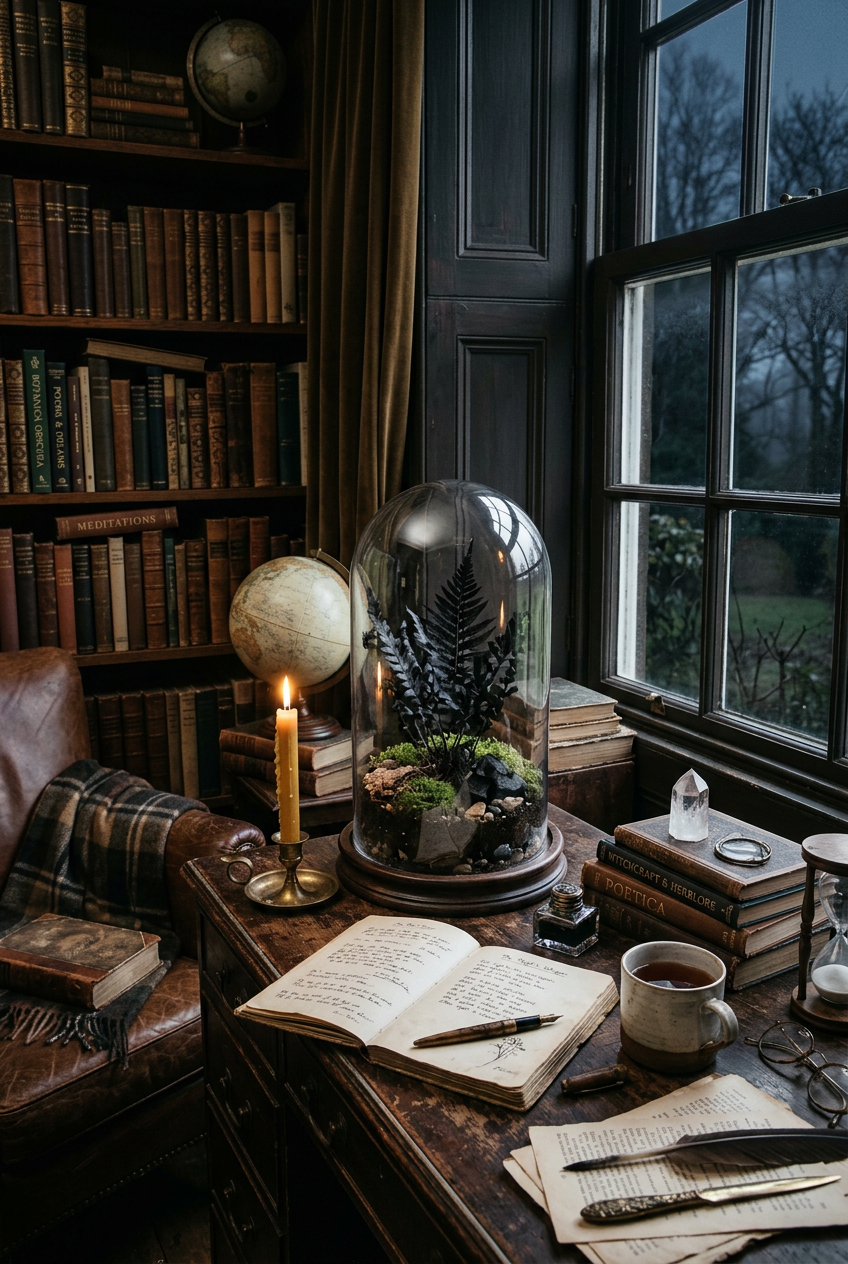
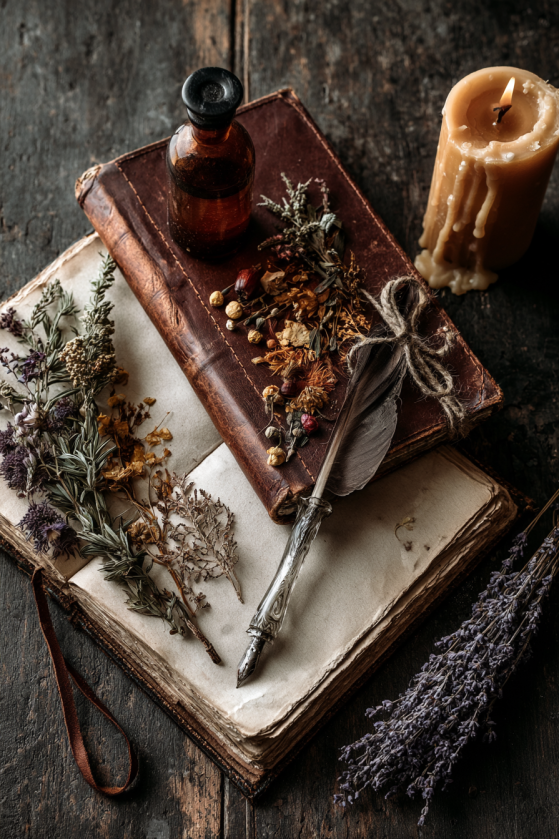
    Bring the witch academia evolution to life with a Leather-Bound Journal for ink-stained pages, Amber Glass Apothecary Bottles for dried herbs and curiosities, a Quill Pen or Glass Dip Pen for that old-world writing ritual, Dried Lavender and Herb Bundles for the signature herbal exhale, Pure Beeswax Candles for warm flickering light, and a Glass Terrarium or Cloche to showcase a single dark fern or botanical specimen.

    The Witchy Scholar’s Philosophy — Reading as Ritual

    There is a distinction worth drawing between decorating a corner and cultivating a nook.

    A witchy reading nook is not a room feature. It’s a practice. The scholar-witch approaches her space the way a naturalist approaches a specimen: with attention, with accumulation, with the quiet understanding that every object placed is also a question asked.

    The poetcore study room takes its shape slowly — not assembled, but accumulated.

    What does it mean to read by candlelight instead of overhead light? (It means you’ve decided the ritual matters.)

    What does it mean to keep a glass jar of dried rosemary on your writing desk? (It means the body needs anchoring while the mind travels.)

    What does it mean to press a flower between pages and leave it there indefinitely? (It means time moves differently in certain rooms.)

    The Naturalist’s Notes — Field Observation I: A reading nook is not made in an afternoon. It is made in the accumulation of choices: the candle placed instead of the lamp switched on, the dried flower saved instead of discarded, the chair angled toward the window instead of the wall. Each small decision is a specimen pinned to the board of the life you are building.

    The poetcore study aesthetic lives here — in the slow deliberateness of a reading life arranged like a poem. Pinterest’s official 2026 Predicts report confirms it: poetcore is the year’s #1 rising aesthetic, with searches for “the poet aesthetic” up +175%. The dark academia reading nook is where poetcore finds its physical form.

    Layer This Look

    Bring the slow, ritualistic poetcore study aesthetic to life with a Leather-Bound Journal for ink-stained pages, Pure Beeswax Candles for warm flickering light, Amber Glass Apothecary Bottles for dried herbs and curiosities, Dried Lavender and Herb Bundles for that signature herbal exhale, and a Glass Dip Pen for the tactile pleasure of writing by candlelight.

    Books as Decor: Styling the Dark Academia Reading Nook Shelf

    In a dark academia study room, books are never just books. They are specimens. They are architecture. They are the evidence of a life conducted with intention.

    The dark academic bookshelf is styled, not stacked. A few principles that hold:

    Group by spine colour. Dark green, wine, cream, black — the palette of the scholarly shelf. No bright primaries. When spines speak the same colour language, the shelf becomes a composition.

    Turn some spines inward. Pages-out gives a wall of off-white warmth that no paint can replicate. Reserve it for one shelf, not the whole unit. It creates contrast without chaos.

    Leave room for objects. The shelf breathes when a single apothecary jar, a beeswax candle, a small skull, or a glass terrarium holds space between the books. These are not decorations. They are punctuation.

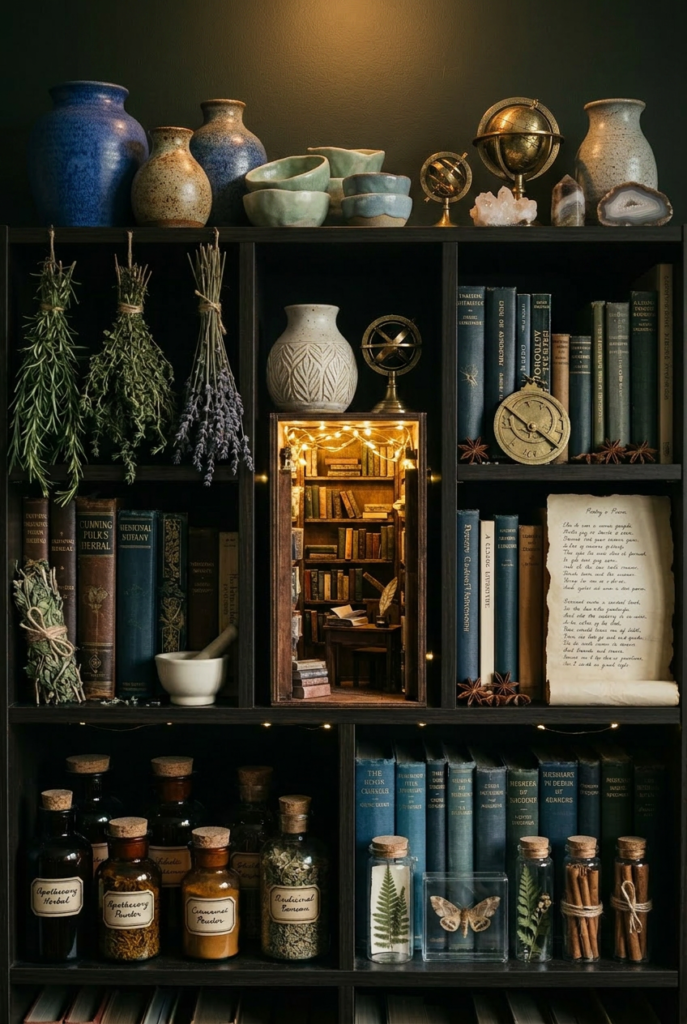
    Add a book nook insert. Library book nook shelf inserts — handmade dioramas of candlelit libraries, apothecary rooms, Victorian reading rooms — are among the top-selling dark academia products right now. An insert transforms one shelf bay into a portal. This is the detail that photographs and pins.

    Layer This Look

    Style your dark academia bookshelf with Leather-Bound Books grouped by spine colour, Amber Glass Apothecary Bottles placed as punctuation between volumes, Pure Beeswax Candles for warm flickering light, a Glass Terrarium or Cloche to showcase a single botanical specimen, and a Library Book Nook Insert to turn one shelf into a miniature glowing portal.

    Botanical Touches for Your Dark Academia Reading Nook

    The distinguishing signature of the @MidnightBotanical dark academia reading nook is what grows in it.

    The dark botanist reading nook is a specific evolution — the scholar’s library grown over, reclaimed by what lives.

    Not loud, not tropical — low and considered. The botanicals that belong in a witchy study nook are the ones that ask you to slow down long enough to notice them.

    Dried lavender bundled with brown twine. Slipped into a shelf gap or laid across an open book. It doesn’t ask for water. It asks you to notice time.

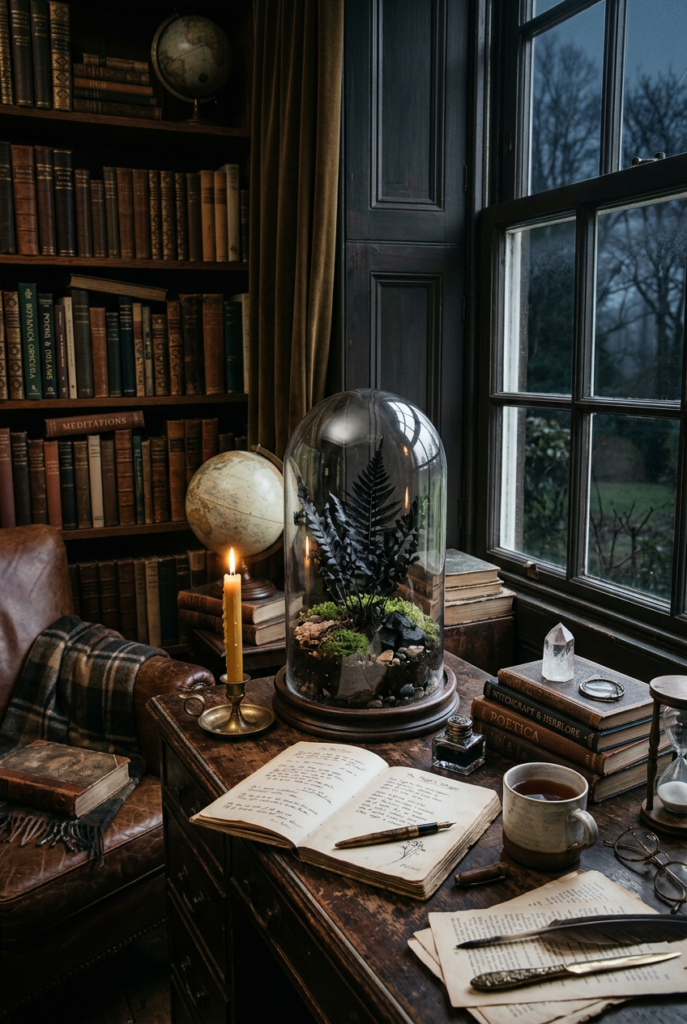
    A Victorian terrarium. A Wardian case holding a single dark fern or trailing moss is the apothecary’s equivalent of a statement lamp. Light passes through the glass differently than it passes through air — it refracts, pools, illuminates the miniature world within.

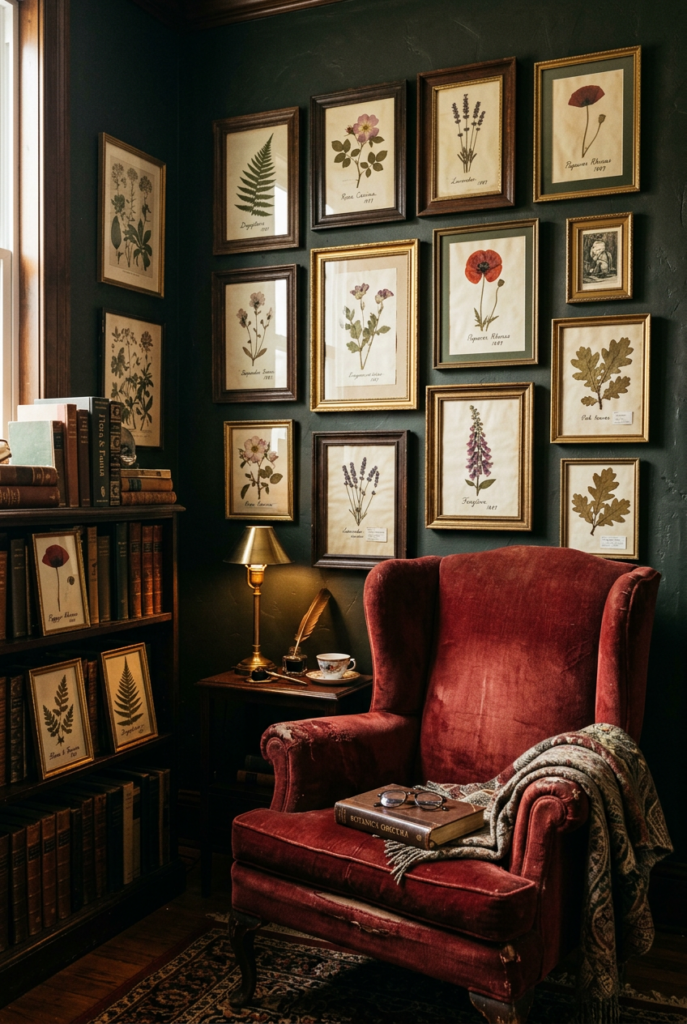
    Pressed flower frames. Single specimens — a dark pansy, a dried rose, a pressed fern frond — in thin black frames. Hung in a cluster above the reading chair or propped against book spines, they make the wall biographical.

    Living herbs for the witch herb garden study. Rosemary for memory. Sage for clarity. A single dark-leafed basil on the windowsill. The study that smells like rosemary is the study where actual thinking happens.

    Dried eucalyptus or honesty seed pods in a dark clay vessel on the desk. They don’t move. They don’t need tending. They are simply themselves — which is exactly the quality that a well-curated nook requires.

    Layer This Look

    Bring the dark botanist reading nook to life with Dried Lavender Bundles tied with twine, a Victorian Glass Terrarium or Wardian case for a single dark fern, Pressed Flower Frames in thin black frames, Living Herbs like rosemary and sage in small terracotta pots, and Dried Eucalyptus or Honesty Seed Pods arranged in a dark clay vessel.

    Candlelight and Apothecary — The Study Altar Corner

    Every witchy reading nook has a corner that functions like an altar — though you would never call it that in polite company.

    It begins with light. Not overhead, not harsh — the kind that pools. A stained-glass / Tiffany-style reading lamp in forest green and amber glass casts exactly the right warmth: jewelled, not fluorescent. These lamps appear in every 2025–2026 editorial guide to dark academia reading nook styling, for good reason. They function as both light source and art object, and they hold the corner together around them the way a hearth holds a room.

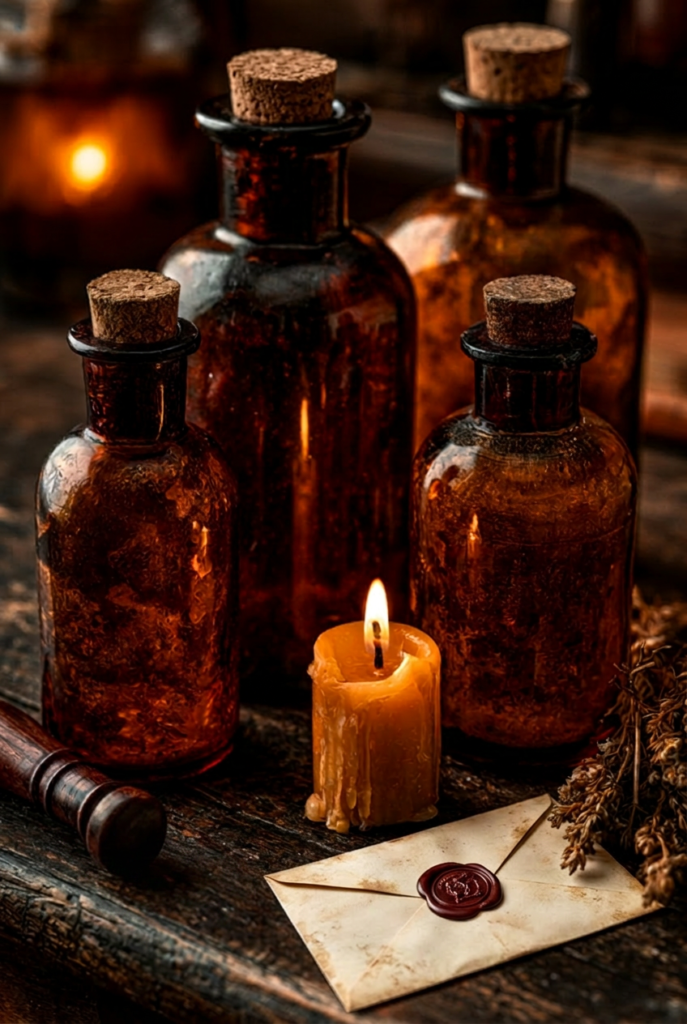
    Then: the apothecary. Dark glass bottles filled with dried herbs, corks sealed with dark wax. A small dish of dried rosemary pods. A beeswax candle that smells of sandalwood and old paper — specifically the haunted library category of bookish candles that consistently tops Etsy’s dark academia bestsellers. The apothecary corner does not have to be large. Three objects, well chosen, read more intentionally than a full shelf of curated chaos.

    The Naturalist’s Notes — Field Observation II: The apothecary corner is a system of signals. The amber bottle says: something is stored here that matters. The beeswax candle says: this room is worth the cost of light. The wax seal says: words leave this place, carefully. Together, they say: this is a place where a person lives deliberately.

    Finally: a wax seal and stamp. Left casually on the corner of the desk, as if letters are written here regularly. They need not be. The object implies they are, and implication is enough.

    Layer This Look

    Create the perfect study altar corner with an Amber & Green Tiffany-Style Reading Lamp for jewelled pooled light, a set of Amber Glass Apothecary Bottles with Cork Stoppers for dried herbs and curiosities, Pure Beeswax Candles with a sandalwood or haunted library scent, and a Wax Seal Stamp Set left casually on the desk for that deliberate, ritual touch.

    The Writing Desk — Ritual Surface of the Dark Academia Reading Nook

    A reading nook without a writing surface is incomplete. The desk is where the reader becomes the writer — where the books exhale their ideas back into the world.

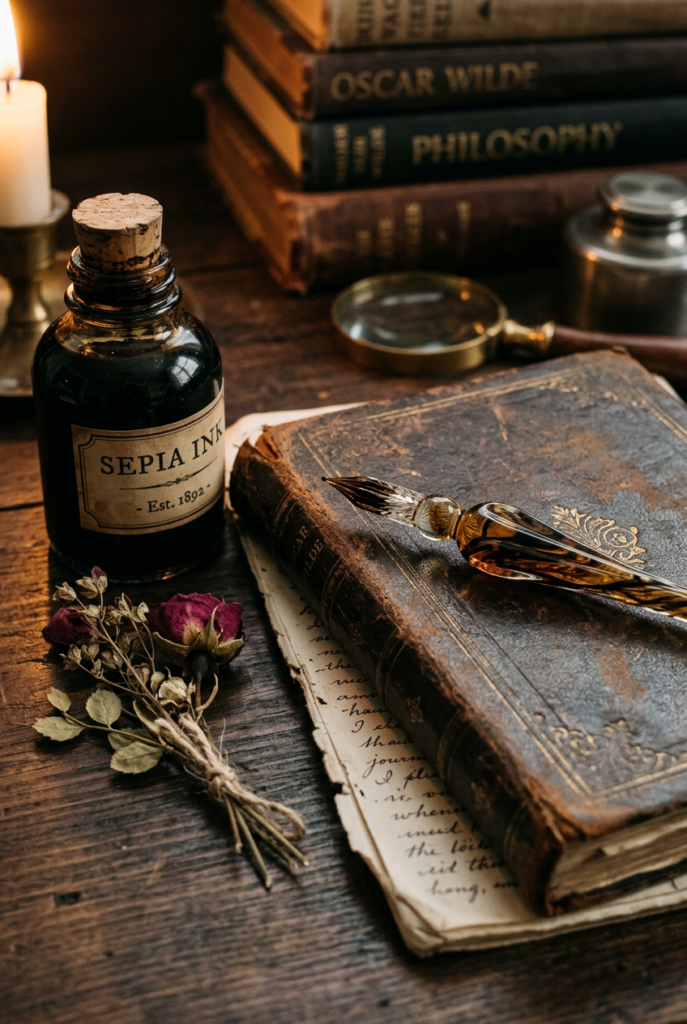
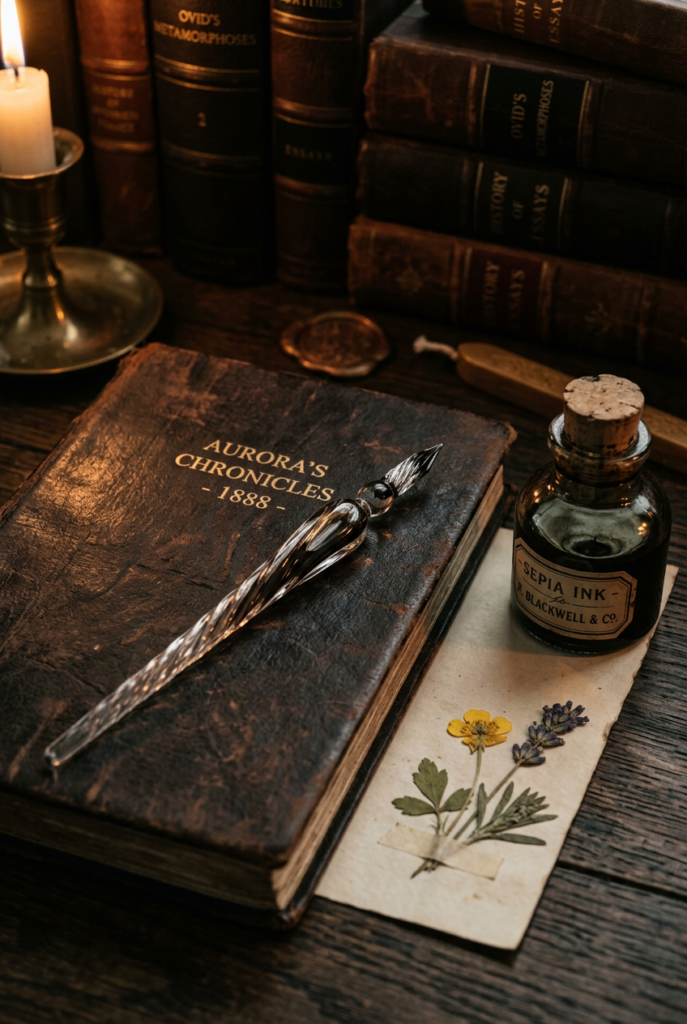
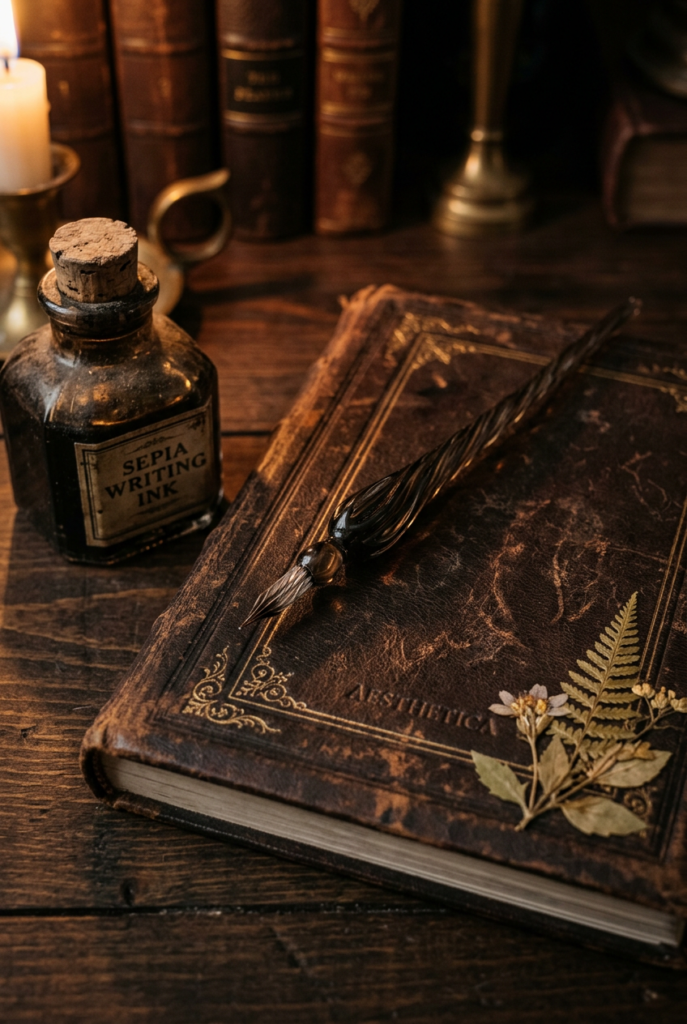
    The dark academia writing desk is spare but not empty. A leather-bound journal open to a blank page. A fountain pen or glass dip pen resting on its side. An ink bottle — sepia, forest green, or near-black — with the cap left slightly ajar. A small plant keeping company near the window: rosemary, or a single dark-stemmed herb that needs little tending. A half-burned beeswax candle. Nothing more.

    The dark apothecary bookshelf decor principle extends here: every object on this desk has a reason for being present, and its reason is readable. The inkwell says: words matter. The plant says: living things belong here. The candle says: this is not just work.

    For the surface itself: dark wood finishes (walnut, ebony-stained oak) anchor the desk within the palette. If your desk is light wood or laminate, a dark leather desk pad resolves the contrast problem in one move and photographs beautifully in every season.

    The witch herb garden study detail lives here too — a small pot of rosemary or sage on the desk edge, nothing dramatic, just the quiet scent of it when the morning is cold and the candle is new.

    Layer This Look

    Create the perfect study altar corner with an Amber & Green Tiffany-Style Reading Lamp for jewelled pooled light, a set of Amber Glass Apothecary Bottles with Cork Stoppers for dried herbs and curiosities, Pure Beeswax Candles with a sandalwood or haunted library scent, and a Wax Seal Stamp Set left casually on the desk for that deliberate, ritual touch.

    Trending This Season — Poetcore and the Botanical Revival

    Poetcore is the quiet heart of the new dark academia.

    It is the moment the scholar becomes the poet — when the reading nook is no longer just a place to consume words, but a place to create them. It lives in the slow turn of a page, the scratch of a glass dip pen on cream paper, the deliberate placement of a pressed flower between verses. It is dark velvet, candlelight, and the faint scent of dried herbs drifting from an open journal.

    Where classic dark academia celebrated the library, poetcore celebrates the desk — the intimate space where ideas are born, annotated, and preserved. It pulls the botanical deep into the aesthetic: rosemary for memory, lavender for calm, a single dark fern under glass like a living poem. The result is something richer and more alive than the original aesthetic: a reading nook that feels less like a stage set and more like a private ritual.

    Poetcore is what happens when the witchy scholar finally sits down to write.

    Dark academia is back — and it’s gone botanical. The witchy reading nook is the new upgrade to the classic library aesthetic: a space where leather spines share shelves with dried lavender, pressed ferns rest between pages, and the warm glow of a Tiffany lamp falls across both poetry and potion jars. It is darker, more alive, and far more intentional than the original aesthetic — a reading corner that doesn’t just hold books, but quietly grows with them.

    Gothic romantasy has quietly become the aesthetic successor to classic dark academia on BookTok. Where the original aesthetic lived in quiet libraries and scholarly restraint, gothic romantasy brings dark velvet, flickering candlelight, and leather-bound spines into a more romantic, slightly haunted space — one where books feel less like objects and more like living spells. It is the natural evolution of the witchy reading nook: deeper, more sensual, and unapologetically atmospheric.

    May is prime reading nook season — graduation gifting plus summer room refreshes create the year’s peak buyer window for dark academia decor.

    Note: Book nook shelf inserts are among Etsy’s top-selling dark academia products right now, with new releases driving fresh attention. These handmade library dioramas turn any bookshelf into a candlelit reading sanctuary.

    Layer The Look — The Poetcore Reading Chair Corner

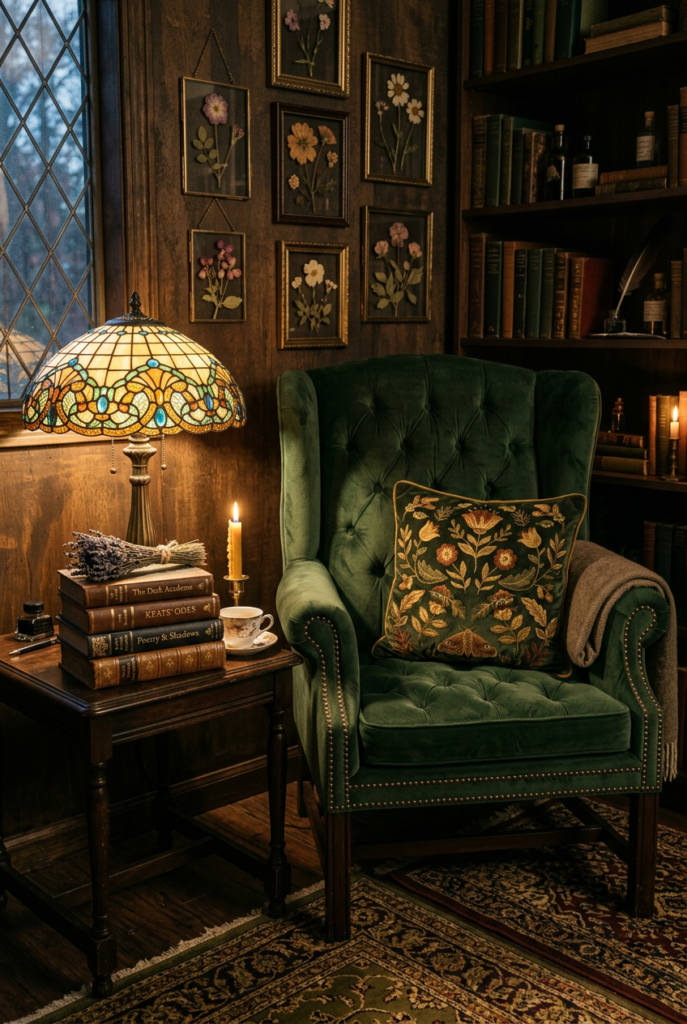
    Capitalize on the 2026 poetcore and botanical revival with a Forest Green Velvet Wingback Armchair as the centerpiece, an Amber & Green Tiffany-Style Reading Lamp for signature jewelled light, a Library Book Nook Insert to create an instant glowing portal on any shelf, Dried Herb Bundles for authentic botanical texture, and Amber Glass Apothecary Bottles to complete the witchy scholar look.

    The Reading Chair Corner — Anchor of the Poetcore Nook

    The chair you read in matters more than you think. It holds the body while the mind is somewhere else entirely.

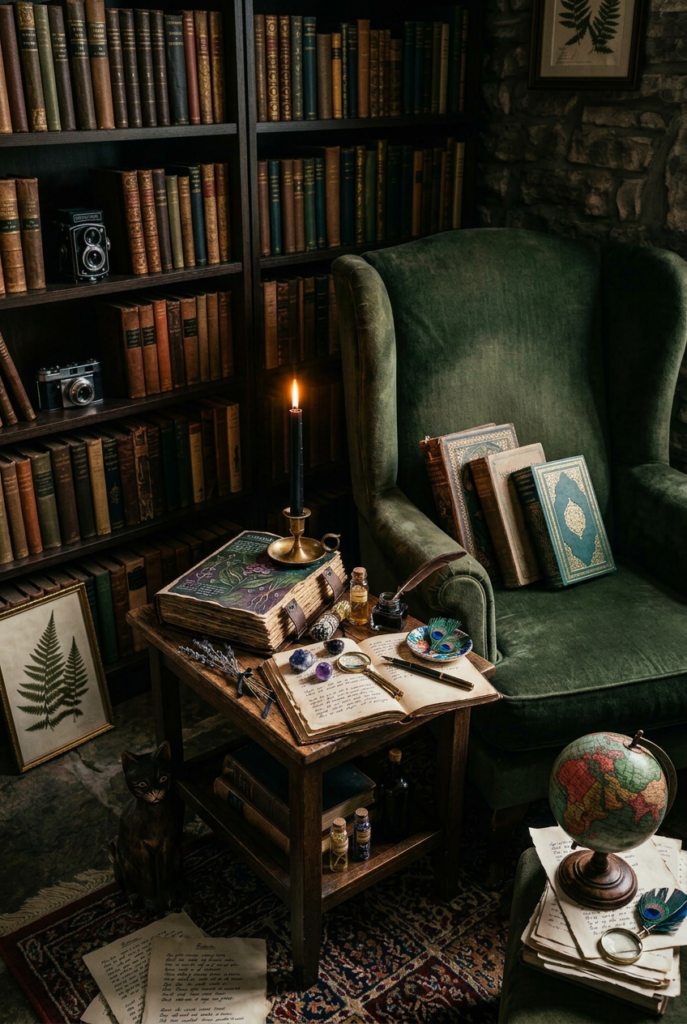
    This is the anchor piece of a dark academia reading nook. The ideal is a dark velvet wingback armchair in forest green, wine red, or near-black. If that is not your space or budget right now, a linen armchair in oatmeal or charcoal draped with a dark botanical velvet throw reads just as well in photographs and in practice.

    Poetcore reading nook decor is defined by deliberate accumulation — nothing bought in a single session.

    Build the corner around the chair:

    Left side

    A stained-glass Tiffany reading lamp on a dark wood side table — the jewelled light does the atmospheric work.

    Right Side
    A stacked tower of 3–4 books, largest at base, topped with a small dried botanical arrangement or beeswax candle.

    Behind the chair
    A pressed flower gallery wall — 3 to 5 thin black frames holding individual specimens — or a single large dark botanical print.

    Underfoot
    A layered rug for depth — a jute or sisal base beneath a small patterned vintage-style rug in deep olive, wine, or charcoal tones..

    Layer The Look

    Anchor your poetcore reading nook with a Forest Green Velvet Wingback Armchair as the throne, an Amber & Green Tiffany-Style Reading Lamp for jewelled light, a Dark Botanical Embroidered Velvet Throw Pillow, a Layered Vintage-Style Area Rug in deep tones, and Pure Beeswax Candles for that signature warm flicker.

    Build the Shelf in Four Zones:

    Zone 1 — The Books
    Color-grouped, spine-to-spine, with a book nook insert in the center bay that glows faintly as if a candle burns within. Pull two or three volumes slightly forward so they angle outward — this breaks the flat-wall effect and creates depth in photographs.

    Zone 2 — The Botanicals
    Dried lavender at the shelf’s end, honesty seed pods in a small dark vase, a single pressed specimen in a thin black frame propped at a slight lean. These live in the gaps between book groups, not in dedicated botanical corners. They find the spaces.

    Zone 3 — The Apothecary
    Three amber or dark glass bottles at varying heights, cork stoppers, a thin film of dried herb visible through the glass. A small beeswax candle. A mortar-and-pestle if you have one — pure visual vocabulary for the **witch herb garden study** corner *(affiliate link placeholder — search: `marble mortar and pestle dark` on Amazon)*.

    Zone 4 — The Object
    One unexplained object per shelf. A small brass key. A folded letter sealed with dark wax. A smooth piece of dark obsidian. A bird skull from a nature walk. These give the shelf narrative — the impression that a particular person lives here and leaves traces.

    Shop the Look

    *This post contains affiliate links. If you shop through my links, I may earn a small commission at no extra cost to you. I only recommend products I believe genuinely belong in a witchy study nook.*

    **1. Handmade Library Book Nook Shelf Insert — Etsy**
    The one detail that transforms a bookshelf into a portal. Look for the Wizard Library or Pandora Box Diorama styles from small Etsy makers — each insert is a miniature candlelit reading room that photographs like a dream and functions as the visual anchor of any dark academia bookshelf.
    → Search “library book nook insert” on Etsy *(affiliate link placeholder)*

    **2. Dark Academia Haunted Library Scented Candle — Etsy**
    Old paper, sandalwood, amber — the scent vocabulary of the scholar’s study. Etsy’s bookish candles in the “haunted library” category are top-sellers for a reason: they smell exactly like the aesthetic looks. Low price point, highly gift-able, and an easy impulse purchase for the reading nook corner.
    → Search “haunted library candle dark academia” on Etsy *(affiliate link placeholder)*

    **3. Stained-Glass / Tiffany-Style Reading Lamp — Amazon or Wayfair**
    The statement lamp that does double duty: light source and art object. Butterfly, floral, and Art Deco designs in amber and forest green glass suit the dark academia reading nook palette precisely. The amber and green colorway is the one to look for.
    → Search “Tiffany reading lamp amber green” on Amazon *(affiliate link placeholder)* or Wayfair *(affiliate link placeholder)*

    **4. Leather-Bound Writing Journal — Etsy or Amazon**
    The dark academia writing desk is incomplete without one. Look for dark brown or near-black leather covers, gilt or dark-edged pages, and thick cream paper weight. Refillable designs are the most sustainable long-term option.
    → Search “dark academia leather journal” on Etsy *(affiliate link placeholder)*

    **5. Apothecary Glass Bottle Decor Set — Etsy**
    Amber or dark glass, cork stoppers, varying heights — grouped in threes, these become instant shelf vocabulary. Fill them with dried herbs, sea salt, lavender, or small pressed flowers for extra authenticity.
    → Search “apothecary glass bottles decor set” on Etsy *(affiliate link placeholder)*

    **6. Pressed Dark Botanical Specimen Print — Etsy (Digital Download)**
    Black-background botanical illustrations in thin black frames: ideal above the reading chair, leaning against book spines, or clustered in a small gallery wall. Digital download = immediate, sustainable, and affordable.
    → Search “dark botanical print printable” on Etsy *(affiliate link placeholder)*

    **7. Dark Velvet Wingback Reading Chair — Wayfair or Amazon**
    The anchor piece of any dark academia reading nook worth sitting in. Forest green and wine are the strongest colourways for the palette. This is the investment piece the whole corner is built around.
    → Search “dark velvet wingback chair” on Wayfair *(affiliate link placeholder)* | also search: `dark velvet wingback accent chair` on Amazon *(affiliate link placeholder)*

    **8. Victorian Glass Terrarium / Wardian Case — Wayfair or Amazon**
    One dark fern or trailing moss inside a Wardian case is the single most atmospheric plant display available for a witchy study. The glass refracts the reading lamp light beautifully, making the plant the most interesting object in the corner.
    → Search “Wardian case glass terrarium” on Wayfair *(affiliate link placeholder)* | also search: `glass terrarium planter dome victorian` on Amazon *(affiliate link placeholder)*

    **9. Dark Academia Bookends with Gothic Motif — Etsy or Amazon**
    The functional detail that doubles as shelf sculpture. Owl, skull, floral, or botanical motifs in dark wood or dark metal finishes keep the bookshelf grounded and intentional on both ends.
    → Search “dark academia bookends gothic” on Etsy *(affiliate link placeholder)* | also on Amazon *(affiliate link placeholder)*

    **10. Dried Botanical Bundle — Etsy**
    A dried lavender bundle or eucalyptus sprig slipped into a shelf gap or arranged in a dark clay vessel is the fastest, most affordable upgrade available to a dark academic study corner. And it smells correct.
    → Search “dried botanical decor bundle” on Etsy *(affiliate link placeholder)*

    **11. Wax Seal Stamp Set — Etsy or Amazon**
    On the writing desk, a wax seal and stamp imply a life of intentional correspondence — even when they are entirely decorative. Dark red, forest green, or midnight blue wax suits the @MidnightBotanical palette. Look for botanical, moon, or fleur-de-lis designs.
    → Search “wax seal stamp set botanical” on Etsy *(affiliate link placeholder)*

    **12. Dark Botanical Embroidered Velvet Throw Pillow — Etsy**
    The tactile centrepiece of the reading chair corner — botanical embroidery in deep wine and gold thread on dark velvet. A single pillow transforms any chair into a dark academia reading seat.
    → Search “botanical embroidered velvet throw pillow” on Etsy *(affiliate link placeholder)*

    **13. Layered Vintage-Style Area Rug — Amazon**
    The base layer of the reading chair corner. A jute or sisal base rug under a small dark-toned patterned rug in wine, olive, or charcoal creates the layered, lived-in floor effect that photographs beautifully and grounds the space.
    → Search “vintage style layered area rug dark tones” on Amazon *(affiliate link placeholder)*

    **14. Dark Leather Desk Pad — Amazon**
    The simplest fix for a light-wood or laminate writing desk. A dark leather desk pad resolves the palette contrast in one move, photographs well in every season, and adds tactile authenticity to the writing surface.
    → Amazon ASIN: B082F5ZLS5 *(affiliate link placeholder)*

    **15. Botanical Flower Pressing Kit — Etsy**
    The tool that lets you make the details in this post yourself — pressed specimens for frames, book page inserts, and shelf styling. Kits range from simple pressing boards to full botanical specimen collections.
    → Search “botanical flower pressing kit” on Etsy *(affiliate link placeholder)*

    **16. Dark Velvet Botanical Throw Blanket — Etsy**
    Folded over the reading chair arm or draped across the seat, a dark velvet blanket with botanical print finishes the chair corner with the exact texture and colour weight the aesthetic needs.
    → Search “dark botanical velvet throw blanket” on Etsy *(affiliate link placeholder)*